Risk Management Redefined ICIEC's Strategic Scaling Capital Efficiency and Smart Transformation at ICIEC

In an era marked by relentless technological disruption-driven by advances in AI, blockchain, and digital trade-and compounded by shifting global trade patterns and mounting geopolitical tensions, the complexity of the global risk landscape has reached unprecedented levels.
In this dynamic environment, robust and adaptive risk management is not just important—it is indispensable. For ICIEC, the credit and political risk insurance arm of the AAA-rated Islamic Development Bank (IsDB), this challenge is especially acute.
With a core mandate to catalyse investment and trade across its Member States- often in high-risk markets-ICIEC must navigate this volatility with precision and foresight. Recognizing that traditional risk models are no longer sufficient, ICIEC has embraced a transformative approach. Moving beyond the conventional “one-size-fits-all” paradigm, the Corporation has redefined risk as a strategic lever-one that enhances capital efficiency, drives institutional agility and fosters resilience.
This new risk ecosystem balances capital preservation with optimization, guided by a calibrated risk–return lens tailored to its non-funding development mandate.
At the heart of this transformation, ICIEC’s risk management function has evolved into a forward-looking enabler of growth and innovation. From embedding dynamic portfolio analytics to advancing enterprise-wide resilience, risk now sits at the core of the Corporation’s transformation agenda.
Strong Institutional Foundation, Now Reimagined
Since its founding in 1994, ICIEC has served its 50 Member States through Shariah-compliant risk mitigation tools, solidifying its status as a global player in the Credit and Political Risk Insurance (CPRI) industry.
While historically focused on preserving capital and minimizing loss, ICIEC is now leveraging its risk function to optimize performance, unlock capital, and enhance insurance capacity—while maintaining conservative risk parameters to ensure all-time solvency and resilience.
Its strength is further magnified by the IsDB’s AAA-rated umbrella effect, benefiting from Preferred Creditor Status (PCS) and Preferred Creditor Treatment (PCT), which provide enhanced credit protection through sovereign support from Member States. As of 2024, PCT-backed exposures, from Sovereigns, State Owned Entities (SOEs), and Financial Institutions (FIs) of Member States, account for 88% (gross) and 80% (net) of ICIEC’s portfolio, reinforcing the quality and resilience of its insurance book.
Recent years have challenged the boundaries of risk management amid rising geopolitical volatility, climate-related shocks, inflation, and debt vulnerabilities. For ICIEC, this marked not just a moment for reflection, but a turning point for strategic transformation.
Risk Management as a Strategic Lever
ICIEC remains committed to operational excellence, continuously enhancing its underwriting, reinsurance, risk management, reserving, and internal audit functions. By maintaining a balanced approach, ICIEC supports Member States while ensuring a sound and resilient portfolio.
To align with evolving global risk dynamics, ICIEC has refined its Risk Appetite Statement (RAS 2.0) and Risk Management Framework (RMF 2.0). Key risk priorities for 2025 include:
- Enhancing portfolio reserving in compliance with IFRS 9 and IFRS 17.
- Implementing a Risk-Based Pricing (RBP) model.
- Advancing enterprise-wide stress-testing methodologies.
These initiatives are designed to strengthen ICIEC’s forward-looking risk capacity, enabling smarter decision-making and ensuring institutional resilience in a fast-changing world.
Capital Optimization and Financial Flexibility
ICIEC’s capital optimization journey gained momentum through the 3rd General Capital Increase (GCI), which raised the Authorized Capital to Islamic Dinar (ID) 1 billion (equivalent to USD1.4 billion). With over 87% of Member Country shares confirmed and phased payments already underway, ICIEC is significantly expanding its riskbearing capacity. The subscriptions so far have increased ICIEC’s insurance capacity by 57%.
Smart Growth Anchored in Resilience
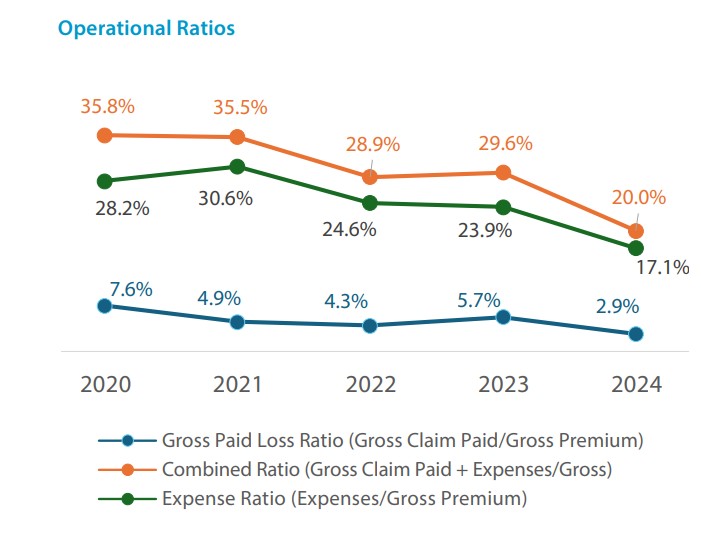
The outcomes of ICIEC’s redefined risk model are clearly visible. The Corporation posted a record net surplus of USD24.9 million in 2024, with its combined ratio improving to 20.0%, down from 35.8% in 2020. This was driven by enhanced underwriting and cost efficiencies.
From 2020 to 2024, ICIEC insured USD57.5 billion in new business, accounting for 47% of the cumulative total of USD121 billion since inception. Gross Written Premiums (GWP) rose 67%, from USD85.8 million in 2020 to USD143 million in 2024.
Gross exposure increased 16% annually. The 2024 exposure mix was 21% short-term (ST), 15% medium-term (MT), and 64% foreign investment insurance (FII).
Credit Rating and Capital Efficiency Impacts
ICIEC has maintained a Moody’s Insurance Financial Strength Rating (IFSR) of Aa3 for 17 consecutive years. In 2024, it secured an additional rating from S&P Global Ratings AA-, for both issuer credit and financial strength, which was reaffirmed in 2025 with a stable outlook. S&P also assessed ICIEC’s enterprise risk profile as strong and its financial risk profile as very strong. These high-grade ratings underscore strong market confidence in ICIEC’s risk management practices and financial resilience, positioning it among the top-rated institutions in its segment.
The AA- rating, further supported by the IsDB’s AAA umbrella effect, provides strong credit confidence and significantly enhances ICIEC’s stature in international financial markets. This high-grade rating allows financial institutions to assign only a 20% risk weight to exposures covered by ICIEC, thereby providing up to 80% capital relief under Basel regulatory frameworks. As a result, ICIEC becomes a more attractive partner for banks, reinsurers, and development finance institutions (DFIs).
For international reinsurers, the rating supports stronger capital calibration, enabling greater capacity for risk transfer involving ICIEC. Financial institutions and investors also view ICIEC-backed policies as high-quality instruments, improving their risk appetite.
Importantly for Member States, the AA- rating translates into more competitive pricing for ICIEC-covered capital market instruments, improving access to international finance and foreign direct investment (FDI). It also supports favourable treatment of ICIEC-guaranteed instruments as high-quality assets, thereby facilitating better financial terms and deeper investor confidence in projects across member states.
Looking Ahead: Risk as an Enabler of Transformation
ICIEC’s capital and liquidity planning, anchored in strategic alignment with the IsDB Group’s Strategic Framework and the phased GCI, positions it for sustainable expansion. Future initiatives include enhanced portfolio reserving, capital modelling improvements, and income efficiency analyses across business lines.
Looking ahead, key priorities include optimizing portfolio pricing, recalibrating capital modelling, and enhancing income efficiency across business lines. The annually published and quarterly updated Risk Perception and Portfolio Direction (RPPD) plays a central role in informing the Business Plan by guiding capital allocation across underwriting activities in line with the RAS.
For strategic and prudent capital allocation within ICIEC’s internal risk framework (EC based consumption), operating countries are classified into Low (Focus Market), Medium (Mixed Market), and High (Cautious Market) risk clusters, based on macroeconomic and geopolitical factors, providing a strategic framework for evaluating political and commercial risks.
Additionally, ICIEC is undertaking a comprehensive, forward-looking capital and risk assessment for 2026–2028, aligned with the upcoming IsDB Group strategic cycle. This assessment aims to integrate historical performance, capital consumption trends, and optimization metrics to ensure long-term solvency and capital efficiency. It is particularly timely as global trade and investment dynamics adjust to a new normal shaped by heightened political risk. The exercise also reinforces ICIEC’s commitment to developmental impact while maintaining financial resilience in an increasingly uncertain global risk landscape.
A Model for Smart Risk Management in Development Finance
At ICIEC, risk management has evolved from a traditional control function into a strategic enabler of institutional transformation. It now underpins the Corporation’s ability to deliver on its mandate with enhanced credit confidence, operational agility, and long-term sustainability.
This paradigm shift marks a fundamental redefinition—from merely preserving capital to prudently optimizing it for sustainable and inclusive growth. Risk Management now acts as a balancing mechanism and a bridge between business operations and the oversight role of internal audit, reinforcing its position as a second line of defense with strategic influence.
This transformation is especially timely as development finance institutions worldwide face mounting expectations to achieve greater impact within increasingly constrained capital and risk parameters. ICIEC’s smart risk approach directly responds to this imperative—balancing risk mitigation with the proactive pursuit of opportunity.
Amid global volatility, ICIEC has consistently outperformed expectations and demonstrated resilience—driven by a deeply embedded risk culture, sound governance, and a forward-leaning stance on economic and financial sustainability. It’s prudent underwriting and strategic capital optimization, and enterprise risk integration have positioned risk management not merely as a safeguard, but as a central catalyst for long-term development value creation.