Mr. Allen Chaizhunussov

CHAIRMAN OF THE MANAGEMENT BOARD OF THE EXPORT CREDIT AGENCY OF KAZAKHSTAN
We are doing more than just insuring deals. We are building the long-term infrastructural connectivity of the region, which strengthens our country’s economic ties and broader trade potential. In this interview, Mr. Chaizhunussov outlines how the Export Credit Agency of Kazakhstan strengthens regional trade by de-risking transactions and integrating exporters into long-term value chains across Central Asia, the CIS, and Azerbaijan, with agribusiness, metallurgy, and infrastructure as priority sectors. He highlights the deepening reinsurance partnership with ICIEC, now spanning 29 issuing banks across multiple markets with 50% ICIEC risk participation, as a cornerstone for scaling insurance capacity and enabling cross-border financing.
Mr. Chaizhunussov, what is the contribution of the Export Credit Agency of Kazakhstan to strengthening trade and investment flows across Central Asia, the CIS region, and Azerbaijan?
Our primary contribution to strengthening trade flows is delivered through direct support for exporters and the systemic mitigation of risks for all participants in foreign trade operations. In 2025, the volume of insurance liabilities we assumed across Central Asian countries reached an impressive milestone, totalling approximately 170 billion tenge, which is around USD 326 million.
Central Asia, the CIS, and Azerbaijan are key strategic priorities for us. Due to geographical proximity and streamlined logistics, these markets already account for a significant share of our efforts to deepen economic integration and expand non-resource exports. We see our role not just in facilitating one-off transactions for Kazakhstani manufacturers but in integrating them into sustainable, long-term regional production and trade chains.
Uzbekistan remains our anchor market in Central Asia, driving the largest share of our supported operations. At the same time, we are observing a steady, progressive strengthening of our positions in Kyrgyzstan and Tajikistan, driven by a consistent demand for ECA support instruments.
We recognise that expanding exports requires a local presence and a deep understanding of market-specific nuances. Our regional directors in Uzbekistan, Tajikistan, Kyrgyzstan, and Azerbaijan serve as critical links in our institutional infrastructure. They focus on three vital objectives: building a robust project pipeline, providing hands-on operational support to cut bureaucratic red tape, and fostering direct collaboration with local banks and importers.
The Export Credit Agency of Kazakhstan provides a comprehensive toolkit that covers everything from the FMCG sector to heavy industry, including metallurgical exports. This ensures that trade flows remain resilient regardless of short-term market volatility.
In your opinion, what are the most promising sectors and corridors for expanding regional trade and economic cooperation in the coming years?
Over the next few years, the most promising sectors will be those where economic complementarity already exists and where Kazakhstan offers a competitive edge capable of scaling within regional value chains.
First and foremost, this applies to agribusiness and the food industry. There is a resilient demand across Central Asia, the CIS, and Azerbaijan for food products, processed raw materials, ingredients, and packaging. Kazakhstan is well-positioned to strengthen its market footprint here through grain, oil and fat, flour milling, meat, and dairy products, as well as highvalue deep processing. This represents one of our most natural and sustainable growth paths.
The second key area is metallurgy and industrial manufacturing, including the chemical and petrochemical industries, which serve as the foundation for scaling our export volumes. The boom in infrastructure development and industrial activity across the region guarantees steady demand for rolled metal, polymers, fertilisers, construction materials, and industrial chemicals. Crucially, these segments offer higher added value and longer contractual horizons.
Another priority is mechanical engineering and equipment, which involves supplying machinery, components, and technical
Kazakhstan is well-positioned to strengthen its market footprint here through grain, oil and fat, flour milling, meat, and dairy products, as well as high-value deep processing. This represents one of our most natural and sustainable growth paths.
solutions for agribusiness, energy, transport, and municipal infrastructure. We view this as a highly strategic area that drives domestic manufacturing localisation and moves Kazakhstan further up the global value chain.
Finally, services and IT, such as engineering, digital solutions, logistics, maintenance, and educational services, are rapidly growing segments that enable Kazakhstani firms to seamlessly integrate into regional and global supply networks.
However, the primary bottleneck to further growth is no longer market demand but rather transaction viability. Today, competitiveness is defined by an exporter’s ability to provide efficient logistics, viable financing, and robust contract structures. Consequently, the focus is shifting away from spot deliveries toward long-term export models backed by financial and insurance mechanisms.
While our current volume of operations in Azerbaijan is still smaller than in Central Asia, this destination is of vital strategic importance in the context of the Trans-Caspian International Transport Route. Building reliable trade corridors between Central Asia, Türkiye, and Europe depends entirely on having a dependable financial infrastructure in place, where export credit and insurance solutions play a foundational role.
Looking back to 2015, the ECA supported a landmark project involving the delivery of cargo locomotives manufactured by Lokomotiv Kurastyru Zauyty to Azerbaijan Railways. This successful initiative laid the groundwork for Kazakhstan to be recognised as a serious industrial and engineering partner in the region.
The Export Credit Agency of Kazakhstan has played an important role in supporting transactions related to infrastructure. How do you see the contribution of export credit and insurance solutions to the development of strategic regional infrastructure?
The ECA of Kazakhstan plays a highly practical, enabling role in infrastructure development. Given the high capital requirements and risks inherent in these large-scale transactions, our instruments serve as a foundation of trust. By shielding clients and investors from commercial and political risks, we make projects bankable and attractive to commercial lenders.
Through export credit mechanisms, we offer buyers access to funding on competitive terms, while our insurance solutions guarantee that all parties honour their contractual obligations. Ultimately, by backing Kazakhstani companies participating in foreign construction and equipment supply contracts, we are doing more than just insuring deals. We are building the long-term infrastructural connectivity of the region, which strengthens our country’s economic ties and broader trade potential.
Today, our portfolio features over 20 distinct instruments that offer flexible support across all stages of the export cycle, from the initial investment phase to final contract execution. We co-insure loans and project financing alongside the Development Bank of Kazakhstan and local commercial banks. We also provide risk coverage for deferred payments granted to importers and secure exporters’ obligations to foreign buyers.
We place a special emphasis on trade finance. By insuring letters of credit with post-financing and establishing credit limits for foreign banks, we help build a stable, cross-border financial infrastructure that benefits exporters, importers, and financial institutions alike.
Agriculture and food security are gaining increasing importance in the region. How does the ECA of Kazakhstan support these sectors, and what opportunities for deepening regional cooperation do you see?
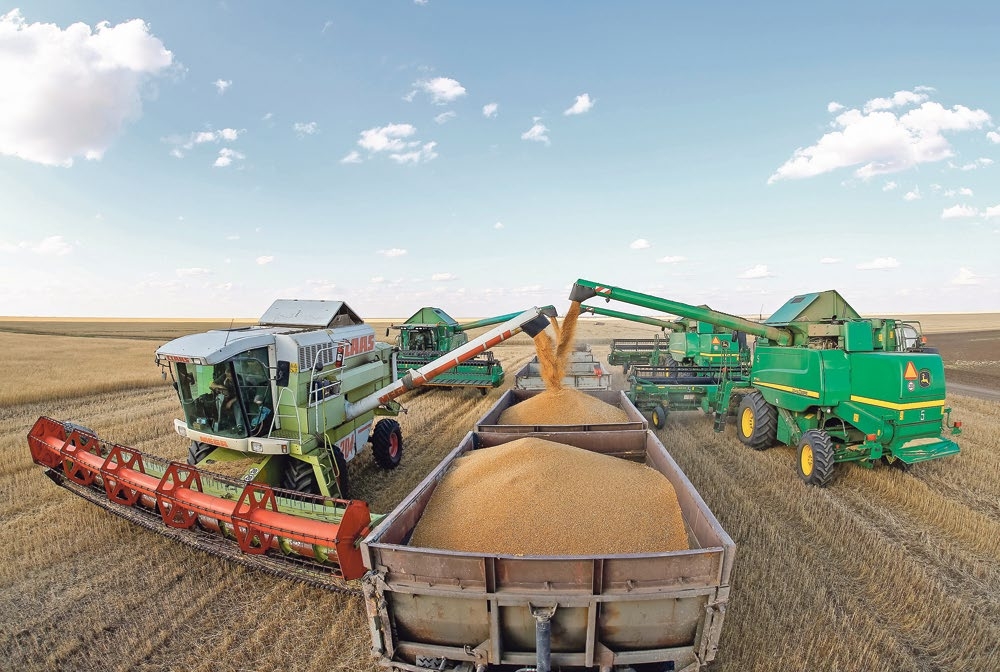
Agriculture and food security have indeed become paramount for the region, and this is a top strategic priority for the ECA of Kazakhstan. By the end of 2025, our export support for agribusiness and food products reached 270.6 billion tenge. Out of this total, 68.6 billion tenge was directed toward Central Asian countries, and 620.5 million tenge went to Azerbaijan.
For the agricultural sector, successful exporting requires more than just moving product; it demands secure settlement mechanisms, predictable demand, and
Agriculture and food security have indeed become paramount for the region, and this is a top strategic priority for the ECA of Kazakhstan. By the end of 2025, our export support for agribusiness and food products reached 270.6 billion tenge. Out of this total, 68.6 billion tenge was directed toward Central Asian countries, and 620.5 million tenge went to Azerbaijan.
reliable access to working capital. To address this, the ECA of Kazakhstan offers tailored support via export credit and accounts receivable insurance, loan insurance, pre-export financing for manufacturers, and trade finance instruments structured in partnership with foreign financial institutions. This comprehensive backing allows Kazakhstani exporters to not only enter foreign markets but also to establish a permanent, sustainable presence.
From a regional cooperation standpoint, there is immense potential in building resilient food supply chains across Central Asia and neighbouring territories. Kazakhstan can serve as a primary food supplier, while neighbouring countries participate as vital links in the broader cooperative chain, including processing, logistics, and distribution. Further opportunities are emerging through the development of trade corridors like the Trans-Caspian Route, which broadens our export geography and enhances regional food security.
How would you assess the value of cooperation between the ECA of Kazakhstan and ICIEC in expanding insurance capabilities and facilitating cross-border transactions?
Our partnership with ICIEC dates back to 2015 and has evolved into a deeply resilient, strategic alliance. Our first landmark project was the reinsurance of the 10-locomotive delivery to Azerbaijan mentioned earlier, where ICIEC covered 70% of the risk. This ten-year facility was successfully concluded in August 2025, proving the efficiency and reliability of our joint framework.
Since 2021, our cooperation has moved to a quota share treaty basis. We run a joint reinsurance programme for export letters of credit issued by banks in Uzbekistan, Tajikistan, and Kyrgyzstan. In 2025, we expanded this geographic footprint to include Türkiye and Azerbaijan. Today, our joint coverage spans 29 issuing banks, with ICIEC taking a 50% risk-participation share in each transaction. Looking ahead, we plan to onboard Mongolian banks into the programme as well. What began as project-based cooperation has matured into a systemic, institutionalised mechanism that expands insurance capacity and drives cross-border operations for Kazakhstani businesses.
What priorities or areas of cooperation would you like to see in the further development between the ECA of Kazakhstan, ICIEC, and other regional partners?
Moving forward, the key priority for the ECA of Kazakhstan is the development of structured transactions, specifically investment projects focused on supplying machinery to Kazakhstani export-oriented manufacturers and developing new export-centered production facilities. Blending our insurance and reinsurance capabilities will allow us to scale up capacity, unlock access to long-term financing, and minimise risks for everyone involved.
Expanding joint insurance coverage for large, complex projects across infrastructure, industry, agribusiness, and logistics remains high on our agenda. The more effectively we can co-insure and mitigate risks, the easier it becomes for regional enterprises to venture into new international markets.
Another critical focus area is the expansion of trade and interbank financing to scale up export volumes. By expanding our network of partner banks, setting up dedicated credit limits, and aligning our risk assessment methodologies, we can significantly accelerate transaction times and make financing much more accessible for international importers.
In this context, maintaining a strong regional presence and deepening institutional cooperation becomes more important than ever. Continuing to build out our network of regional representatives will be essential to engaging directly with local partners, identifying market demand, and providing seamless, on-the-ground transaction support.