Islamic Finance and Export Credit Insurance: De-Risking Investment Across the Trans-Caspian Corridor

Dr. Khalid Khalafalla, CEO of ICIEC, highlighting the transformative role of Islamic finance and export credit insurance in advancing sustainable investment across the Trans-Caspian International Transport Route (TITR). The article examines how Shariah-compliant financial structures and ICIEC’s risk mitigation solutions can catalyse private sector participation, support strategic infrastructure and energy projects, deepen regional connectivity, and foster greater investor confidence throughout Central Asia and the South Caucasus.
Islamic finance and export credit insurance together form a mutually reinforcing development architecture that is highly relevant to unlocking investment across the Trans-Caspian International Transport Route. In this corridor, Islamic finance, anchored in asset-backing and risk-sharing principles, naturally directs capital toward real-economy sectors such as infrastructure, logistics, energy, and trade facilitation. Instruments like sukuk and Murabaha-based trade finance are particularly well suited to the region, as they provide long-term, stable financing aligned with productive investment needs while avoiding excessive leverage in markets where debt sustainability is already constrained.
Within this ecosystem, export credit insurance functions play a critical catalytic role by de-risking cross-border investment flows and converting potential into bankable reality. By covering political, credit, and commercial risks, such as non-payment, currency inconvertibility, or contract frustration, ICIEC enables cross-border investments into higher-risk but high-impact markets, including Kazakhstan, Uzbekistan, Azerbaijan, and Georgia. This de-risking function is especially critical in enabling infrastructure corridors, energy interconnections, and SME trade flows that would otherwise struggle to achieve financial close.
Strategically, the integration of Islamic finance and ICIEC-backed insurance supports three core development outcomes in the corridor. First, it crowds in private capital by improving risk-return profiles for investors, particularly in transport infrastructure, renewable energy, SME-focused investments and industrial development zones. Second, it strengthens intra-OIC and South–South trade connectivity, reducing dependence on traditional financial and logistics corridors while enhancing regional value chain integration across Eurasia. Third, it enables financial inclusion and SME and mid-sized exporters’ participation, especially when insured Islamic trade finance is extended through banks and fintech-enabled platforms in underserved markets.
The most scalable opportunity lies in building blended finance ecosystems, where Islamic financial instruments provide Shariah-compliant capital, ICIEC provides credit and political risk mitigation, and development finance institutions act as anchor investors. This structure is particularly effective for public–private partnerships, cross-border logistics infrastructure, and green energy projects, which are central to the corridor’s transformation agenda. However, scaling remains dependent on enabling conditions such as regulatory harmonisation, stronger project preparation pipelines, and deeper capital market development across participating countries.
Ultimately, the integration of Islamic finance and export credit insurance provides a coherent financial and risk mitigation framework for the Central Asia–South Caucasus corridor. It combines capital mobilisation with risk absorption, enabling structurally important but higher-risk investments to proceed. In doing so, it positions ICIEC as a catalytic intermediary, bridging liquidity and risk to unlock sustainable, inclusive, and resilient investment flows across one of the most strategically significant emerging corridors.
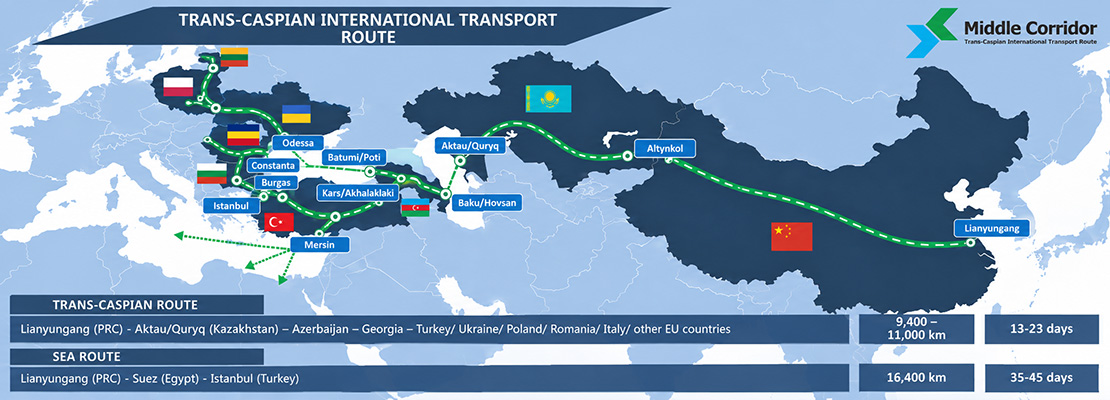
Looking forward, ICIEC is well-positioned to prioritise high-impact countries, sectors, and instruments that align with corridor development. Priority geographies are likely to include Kazakhstan and Uzbekistan (scale and reform momentum), alongside Azerbaijan and Georgia (transit and logistics hubs). Key sectors include transport infrastructure (rail corridors, ports, and logistics hubs), renewable energy (solar, wind, and green hydrogen), conventional energy exports, and digital connectivity. Product selection will centre on political risk insurance, foreign investment insurance, and export credit guarantees, particularly for PPPs and cross-border projects requiring credit enhancement. Flagship opportunities may include upgrades along the Middle Corridor, Caspian-linked energy projects, and integrated trade facilitation platforms that reduce bottlenecks and improve regional competitiveness.
From a geopolitical perspective, the corridor sits at the intersection of competing and converging regional interests, shaping both current and future risk dynamics. Ongoing shifts in global trade patterns, sanctions regimes, and regional alignments are increasing the corridor’s relevance while also introducing volatility. The diversification away from traditional northern routes has elevated the importance of the Caspian pathway, but risks remain linked to regional disputes, border sensitivities, and external power competition. Over the medium term, however, continued economic cooperation, infrastructure investment, and policy alignment among corridor countries could gradually reduce friction and enhance stability. For ICIEC, this means maintaining a forward-looking risk posture, leveraging its risk mitigation toolkit to navigate uncertainty while anchoring investor confidence in a corridor that is becoming central to Eurasian trade and investment flows.
The geopolitical environment adds both opportunity and complexity. The corridor is increasingly relevant due to sanctions-driven trade rerouting, regional realignment, and diversification strategies by global and regional powers. While this enhances its strategic value, it also introduces volatility linked to geopolitical tensions, regional disputes, and policy fragmentation. Over time, gradual integration efforts and infrastructure investments may improve stability, but near-term risk remains elevated and asymmetric across countries.
Within this context, ICIEC’s risk appetite and cover attitude are best described as ‘selective catalytic’. The Corporation maintains a moderate-to-high risk appetite in strategic member states, particularly where its participation can unlock otherwise unbankable investments, but this is done within clearly defined capital protection boundaries. ICIEC continues to cover political and credit risks in higher-risk jurisdictions, while insisting on strong risk structuring, such as sovereign or quasi-sovereign backing, robust contractual frameworks, and diversified risk-sharing arrangements. This approach avoids binary risk acceptance and scales exposure dynamically based on country limits, project quality, and mitigation strength.
ICIEC’s underwriting approach already reflects rigorous country risk assessment frameworks, which are critical in this corridor given varying sovereign risk profiles and political dynamics. These include evaluating macroeconomic stability, debt sustainability, regulatory quality, and exposure to external shocks such as commodity price volatility. For instance, energy-dependent economies like Azerbaijan and Kazakhstan require careful assessment of fiscal buffers and diversification efforts, while reform-oriented markets like Uzbekistan present improving but still evolving risk environments. In the South Caucasus, geopolitical considerations and regional tensions necessitate enhanced political risk analysis, particularly for longterm infrastructure and foreign direct investment projects. These risk diagnostics inform ICIEC’s exposure limits, pricing, and structuring of guarantees and insurance products.
Ultimately, ICIEC’s strategy in the corridor reflects a dual objective: enabling development while preserving capital adequacy and financial sustainability. This will be achieved by deploying risk mitigation instruments to crowd in private capital, prioritising sectors with strong developmental and cash-flow fundamentals and continuously adjusting exposure in response to geopolitical and macro-financial signals. This disciplined yet enabling posture allows ICIEC to act as a stabilising risk intermediary, unlocking corridor opportunities while safeguarding long-term financial viability.
However, to fully realise this potential, several enablers are needed: stronger regulatory harmonisation across jurisdictions, deeper local capital markets, improved project preparation pipelines, and greater awareness among global investors of Islamic finance structures. Without these, scale will remain constrained.
In essence, Islamic finance provides the values-based capital architecture, while export credit insurance provides the confidence mechanism, and together, they can accelerate sustainable, inclusive, and resilient development across emerging and frontier economies.