Making Ratings And Blended Finance Work For Impact Delivery In Sustainable Development – Via Reinsurance


Manager, Reinsurance at ICIEC
Buyers of insurance, both retail and commercial, have generally no dealings with a reinsurance company because reinsurance is a business-to-business transaction. Therefore, most people are not even aware of the existence of reinsurers who, at their end, have historically maintained a relatively low profile. This has changed as reinsurers publicly emerged as safety nets for direct insurers hit by massive disaster losses.
In its simplest form, reinsurance can be defined as insurance of insurance companies. Most insurers generally operate within their national boundaries and often offer cover that is limited to certain regions and customer segments. The capital base of many of those companies is exposed to disaster risk and cannot be simply strengthened without affecting affordability. As such, insurance companies rely on “risk capital” from third parties, in the form of reinsurance, to absorb large losses that unexpectedly deplete claims-paying resources and reduce underwriting capacity (Culp and O’Donnell 2010). Insurers transfer some of their risks to reinsurers in order to protect their balance sheets and to free up capital which, in turn, enables them to provide more risk-bearing capacity to their customers.
Reinsurers can pay for catastrophic losses because of their global diversification of risk portfolios and investment, making protection more broadly available at lower cost and higher security. This is how reinsurance creates value. The essential role of reinsurance is to support recovery efforts after disasters (such as earthquakes, typhoons, and floods) strike. Reinsurers are able to support community recovery efforts by paying claims that help communities rebuild. Equally important is the contribution of reinsurers to alleviating the financial consequences of mortality and health shocks. The recent COVID-19 pandemic serves as a case in point where reinsurers support their direct insurance customers in paying the costs of those who fall ill with the virus and require medical attention as well as by compensating families that have suffered the death of the main breadwinner.
By paying a premium to their direct insurer(s), individuals, households and corporates seek protection against a wide spectrum of specific risks, ranging from car accidents to flood disasters. Direct insurers, in the reinsurance context known as cedants, pass on entire portfolios of risks (where usually all premiums and losses are shared) or large single risks (covering losses exceeding a certain threshold) to globally operating and diversified reinsurers. The original policyholder is not involved in this transaction — the direct insurer remains the contractual partner.
Reinsurers assume the risk and add it to their portfolio of diverse risks. Typically, reinsurers are careful to diversify geographically and by type of risk. In order to limit their own exposure, reinsurers may sometimes pass on some of their risks to other reinsurers (known as retrocession) or to institutional investors who invest in insurance-linked securities.
The Economic and Societal Benefits of Reinsurance
Reducing the cost of risk on the back of global diversification Insurance is fundamentally about pooling: individuals or companies pay a premium in return for financial compensation in the event of a covered loss. The premium paid by the insured (the ‘policyholder’) is calculated so that it allows the insurer to honour its claims payment obligations and meet its non-claims costs such as administration expenditure and the cost of capital. Insurance premiums are a function of the risk covered: the greater the probability of the risk occurring and/or the potential severity of the risk, the higher the premium.
Insurance essentially works as a redistribution mechanism: the premiums paid by policyholders who experience no (or little) claims finance the indemnification of those who are less fortunate. This mechanism works because not all policyholders suffer a large loss at the same time. It is in this sense that the ‘pluricentennial’ motto of Lloyd’s of London — which defines insurance as “the contribution of the many to the misfortune of the few” — shall be understood. This principle of “collective solidarity” which constitutes the very foundation of the insurance and reinsurance business model is rooted in science. The underlying mathematical principles are known as the ‘law of large numbers’ and the ‘central limit theorem’. Intuitively, they state that when one combines a large number of risks which, to a significant extent or at least to some extent, are independent from each other, there is a ‘compensatory’ effect between these different risks. In the case of insurance, this effect occurs between the policyholders who suffer a loss and the policyholders who are not impacted. On this basis, the aggregate loss experience over the entire risk portfolio becomes relatively ‘predictable’. In other words, aggregating a vast number of individual policyholders’ risks creates a risk portfolio which benefits from a lower volatility of claims. How does this mechanism enable the insurer to offer coverage at a lower cost?
Insurers are required by regulators to hold capital that is sufficient to absorb large losses and meet their commitments to all their policyholders with a certain probability, which can be seen as a ‘security level’. The corollary to the diversification effect is that, for a given security level, the total amount of capital that the insurer is required to hold decreases in relative terms when its risk portfolio becomes more diversified, everything else being equal. In other words, diversification reduces the amount of required capital for the coverage of a given policyholder risk and, consequently, lowers the ‘cost’ of insuring that risk.
Now enter the distinction between insurance and reinsurance. It primarily lies in the ability to pool risks. Most insurance companies — including the very large ones — have a local, national or regional footprint, due to the need to maintain distribution networks and close contact with their customers. Therefore, insurers only mutualize risks on a limited geographical scale. While this level of mutualization is sufficient for smaller risks that occur frequently, it may turn out to be insufficient for certain peak events such as a large natural catastrophe hitting a significant proportion of property insurance policies within a given country. For such a catastrophe, risk mutualization needs to be operated internationally or even globally. This is precisely the role of reinsurers. Contrary to most insurers, reinsurers generally have an international or even truly global footprint, allowing them to pool and mutualize risk exposures worldwide.
This is at the heart of the fundamental value proposition of reinsurance companies: they are able to assume a specific unit of risk at lower capital charges and cost than primary insurers who are limited to mutualization on a national level only. This differential in capital requirements for a particular block of business reduces the cost of risk and constitutes the added value of reinsurance, benefiting all insurance policyholders. It also explains why reinsurance is intrinsically a global industry, relying on diversification of risks across the globe, a wide spectrum of business lines and geographies.
Improving Availability and Affordability of Insurance
Narrowing protection gaps — increasing underwriting capacity
By leveraging global diversification, reinsurance is an efficient source of capital for direct insurers. Tapping into it increases insurers’ risk underwriting capacity and allows them to issue insurance policies with higher coverage limits, notably for those peak risks which need to be diversified globally and, in the absence of reinsurance protection, could remain completely uninsured. In other words, reinsurance allows insurers to provide more substantial and/or affordable insurance coverage to their individual policyholders, making the latter benefit from the diversification benefit afforded by global risk spreading through reinsurance. By enabling more and less expensive insurance, reinsurers make a vital contribution to narrowing global protection gaps, i.e. the difference between economic and insured losses.
Enabling innovation
In addition to providing cost-efficient capital, reinsurance is also an enabler or an outright source of innovation, not least due to the major players’ proprietary catastrophe modelling capabilities which have spurred the insurability of major natural disasters, for example. Efforts to model cyber exposures are a more recent example. Also, reinsurers play a major role in supporting their customers’ product development, for example in the areas of critical illness and occupational disability. Ultimately, reinsurers’ innovative credentials help expand the limits of insurability, deepening and broadening available insurance cover and narrowing protection gaps. Having said this, reinsurers face challenges, too, in this context as the frequency of non-modelled risks seems to be rising and climate change trends are blurring the ability to forecast natural disasters.
Disseminating risk knowledge and building risk awareness
Risk knowledge is in its essence, putting a price tag on risks, so society can allocate resources to risk mitigation in the most effective way. As many risks are interconnected and global in today’s world, reinsurers, based on their global pool of data and expertise, are a key resource for tracking these connections and making all stakeholders aware of them. Examples include:
- Longevity, which is influenced by food security, nutrition, climate change, public health care and education. All these influencing factors vary by country and region but are interconnected at the same time. Understanding these interconnections makes it possible to design sustainable pension solutions and provide (real-time) prevention and other services to insureds.
- Renewable energy is key to mitigating climate change. But the sun does not always shine, droughts make hydropower unavailable, and no wind means no energy. Insurance coverages for the lack of sunshine, water or wind smooth revenue streams and make renewable energy projects more attractive to investors. This ultimately accelerates the energy transition.
- Climate change affects the frequency and severity of natural catastrophes, something that the reinsurance industry generally expects and models. For example, 2020 was another active year for natural catastrophes in the U.S. with a record-breaking 30 named storms in the Atlantic and a widespread wildfire season on the West Coast. Insuring farmers, homeowners, businesses, etc. against these perils provides economic stability even if disaster strikes, thereby assuring better livelihoods for the growing population on our planet.
- The cyber space has developed into the backbone of modern economies. Today, cyber insurance helps companies to be back online fast, so that the damage from cyber attacks and incidents does not jeopardize their survival.
- All of the above is only possible if risks are identified, assessed for frequency and severity, and analyzed with an eye to their potential for mitigation so that affordable premiums commensurate with the risk can be determined.
The first step in the risk management examples above is the identification of new or “emerging risks”. Emerging risks come with high uncertainty. They have still to be modelled and are potentially unquantifiable, or they evade or challenge current modelling. Examples include risks associated with new technologies like genetic engineering, nanotechnology, robotics or artificial intelligence.
By identifying and analyzing emerging risks the reinsurance industry provides a societal service. As an absorber of peak risks, reinsurance has developed a unique focus and expertise when it comes to scanning for emerging loss accumulations.
By identifying and analyzing emerging risks the reinsurance industry provides a societal service. In an important second step, reinsurance is instrumental in translating these risks into widely available and affordable insurance solutions. As an absorber of peak risks, reinsurance has developed a unique focus and expertise when it comes to scanning for emerging loss accumulations. Also, reinsurers’ emerging risk research not only enables potential prevention measures but also helps identify limits of prevention and insurability.
Enhancing Macroeconomic Shock Resilience
Re/insurance cover significantly helps economic recovery following a natural catastrophe, as shown in various academic studies (Von Peter et al 2012, Breckner et al 2016, OECD 2018). According to these studies, a higher level of coverage in general is accompanied by significantly better economic performance following a catastrophe. This effect is measured by the long-term effects of large natural disasters on economic activity. If fully insured, these events do not have a significant lasting effect on a country’s GDP level over the longer term. On the other hand, in the absence of insurance cover, there is evidence of a lasting negative effect on economic activity.
Large-scale natural catastrophes have massive economic effects, both direct and indirect. Besides the immediate negative effects resulting from the destruction of production sites, infrastructure, etc., the longer-term consequences should be considered as well. Emerging and developing economies in general are more heavily affected by extreme natural disasters than industrialized countries, not least because their resilience and preparedness levels are (much) lower.
The role of (re-)insurance in limiting the negative implications of extreme events and the resulting macroeconomic costs, especially for the most vulnerable countries, is multifaceted. First, given the global scope of reinsurance, affected countries can draw on readily available international resources to pay for losses. As shown before, this risk-bearing capacity can be provided more cost-efficiently than through self-insurance on a national level. Secondly, (re-)insurance provides incentives for loss prevention, e.g. through incentivizing better building standards. And finally, by setting a price tag on insured properties or business activities, insurance mechanisms increase the efficiency of disaster prevention — as opposed to post-event foreign aid inflows.
Contributing to Sustainable Development — via Reinsurance
By its very nature, reinsurance is an important contributor to achieving sustainable development. By mitigating major losses reinsurers smooth economic volatility and reduce economic shocks. Their extensive expertise uniquely positions them to contribute to the assessment and understanding of new, emerging and changing risks. Furthermore, reinsurers have a long record of driving innovation and the implementation of new technologies such as space technologies (satellites) or, more recently, green tech solutions.
Reinsurers are also well aware of their “corporate responsibility” and are committed to global initiatives such as the UN Sustainable Development Goals (SDGs), the Paris Agreement on Climate Change and many others. Global partnerships for sustainable development as well as voluntary commitments to standards such as those embodied by the UN Global Compact (UNGC), the Principles for Sustainable Insurance (PSI) and the Principles for Responsible Investment (PRI) are common for the reinsurance industry. A good example of cooperation between (re-)insurers and supranational organizations is the production of “Global guidance on the integration of environmental, social and governance risks into insurance underwriting” (UNEPFI PSI 2020).
As major institutional investors, reinsurers’ sustainable investing practices support sustainable development. Given the risk competency of reinsurers, the integration of ESG criteria into the investment process is well established in the industry. The establishment of sustainable investment guidelines is common practice in the investment management of reinsurers as are large-scale investments in renewable energy and sustainable real estate and infrastructure. Reinsurers have taken on innovative sustainable finance instruments such as green bonds. Also, initiatives such as the Net-Zero Asset Owner Alliance are supported by several reinsurers.
Climate change is one of the main causes of sustainability management. Its societal implications are manifold, ranging from physical and economic risks to changing business models and climate-induced migration (Munich Re 2021). The global reinsurance industry has been vocal about climate change and started to explore this phenomenon as early as in the 1970s, accumulating extensive data, knowledge and experience over the past five decades (Munich Re 2015). Reinsurers understand climate risks and are compensated for assuming such risks in order to support recovery efforts after disasters strike by paying claims that help communities to rebuild.
Reinsurers play an important role in helping societies adapt to climate change. They assume a portion of the financial burden of those affected by natural disasters, allowing them to return to their daily lives more quickly after a loss event. This role is particularly relevant for emerging and developing countries which are most vulnerable to natural catastrophes.
In addition to assuming underwriting risk, reinsurers also engage in a number of other activities and support measures that enable a more rapid adaptation to climate change. For example, they share information and provide education to raise awareness of natural catastrophe risks in both the public and private sector. They also assist in designing policy measures to incentivize the development of private sector risk transfer solutions (e.g. through conducive accounting and taxation rules) as well as Public-Private Partnerships such as catastrophe pools. In addition to risk-reducing insurance solutions geared towards loss prevention and adaptation to climate change, reinsurers also act as enablers of climate-friendly and sustainable technologies and support the transition to a low carbon economy. Knowledge and innovative coverage concepts help expand the frontiers of insurability and facilitate the breakthrough of new technologies. Insurance solutions enabled by reinsurance can protect against specific risks, thereby enhancing the appeal of green technologies for investors and strengthening their financing viability. This includes performance guarantees for renewable energy technologies (offshore wind farms and solar parks, for example) and support for hydrogen or methane fuel cell technology.
Conclusions and Recommendations
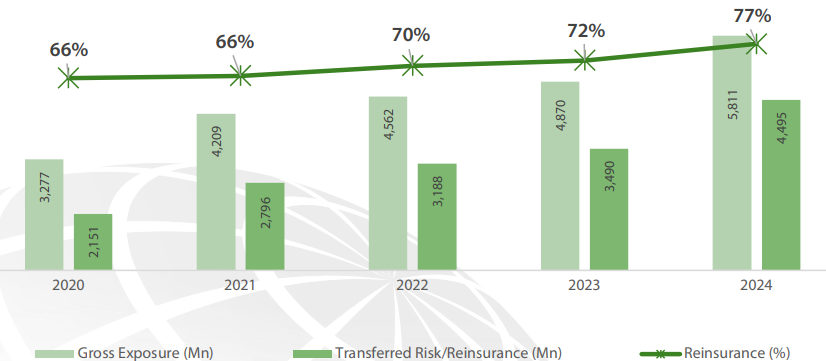
ICIEC has strategically leveraged the international reinsurance market to enhance its operational efficiency and expand its capacity. This prudent approach has strengthened portfolio diversification through effective risk transfer while improving financial flexibility. Notably, the reinsurance cession transfer rate increased from 66% in 2020 to 77% as of 2024, reflecting the continued strong support from the reinsurance market and ICIEC’s ability to optimise risk management by offloading exposures from its balance sheet. The risk transfer strategy also enhances ICIEC’s capacity and ability to support strategic and impactful projects in its Member States.
For reinsurance to benefit the economy and society it needs to operate globally. Global scale and risk diversification allows reinsurers to assume very large and complex risks in an affordable way. As such, reinsurers are a major source for stable and shock-resilient domestic insurance markets. In countries like Chile and New Zealand, for example, global reinsurers generally pay for the lion’s share of earthquake disasters, which otherwise may not be insurable at all, falling on domestic households, businesses and taxpayers in their entirety.
Reinsurance can play its economically and societally beneficial role only if certain basic policies and regulatory conditions are met. A key prerequisite is reinsurers’ unfettered ability to operate on a cross-border basis, i.e. the freedom to provide services. Reinsurers also require the ability to use their worldwide pot of premium to pay for local claims. Restrictions on the free flow of capital, e.g. through deposit requirements imposed on foreign reinsurers, impair their ability to move capital to cover major events which would ultimately drive up the cost of cover. (Source: GRF 2021)
Reinsurance Exposure (USD Mn)