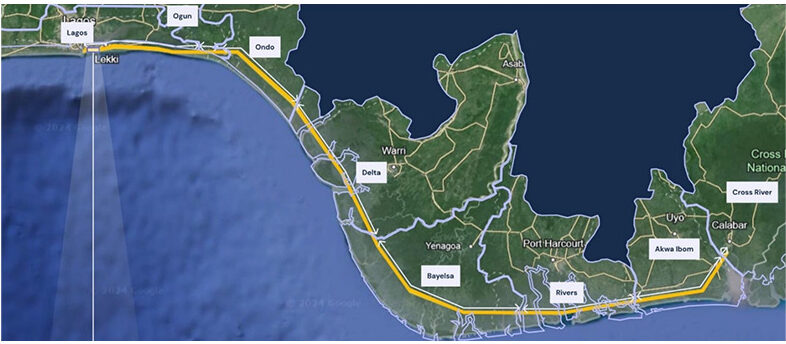
ICIEC has extended vital risk-mitigation support for a landmark infrastructure project in Nigeria—the first phase of the Lagos–Calabar Coastal Highway, known as Project Hermès. The Corporation was approached by Deutsche Bank (Germany) and First Abu Dhabi Bank (UAE) to provide Non-Honoring of Sovereign Financial Obligation (NHSFO) insurance for a USD 300 million Islamic financing facility extended to the Federal Government of Nigeria through the Ministry of Finance. Under this engagement, ICIEC is insuring 95% of Deutsche Bank’s portion and 90% of FAB’s for a combined insured amount of USD 465.96 million.
The financing supports Phase 1a of the Lagos–Calabar project, a transformational 47.7 km dual carriageway connecting Victoria Island to Eleko in Lagos. Implemented under a Design–Build–Finance model by Hitech Construction Company Limited, the six-lane highway includes a central reserve designed to host a future railway line, along with toll stations, pedestrian and wildlife crossings, and linkages to wider regional trade routes. This segment is part of a broader 700 km coastal corridor planned in nine phases, ultimately linking Lagos with Calabar and integrating Nigeria more deeply into continental routes such as the Abidjan–Lagos Highway and the Trans-Saharan network.
ICIEC’s participation strengthens investor confidence in the project’s financial structure and aligns with its mandate to support Member States in developing critical infrastructure that drives sustainable economic growth. The highway is poised to significantly enhance Nigeria’s transportation landscape, reduce logistics bottlenecks, and improve mobility for goods and passengers. It is also expected to unlock opportunities for underserved communities along the route by improving access to services and promoting local economic activities.
The developmental impact of the project is far-reaching. During peak construction, it is projected to generate around 900 direct and 300 indirect jobs, with a strong emphasis on youth, women, and local workforce participation. At least 40% of contracts are earmarked for SMEs, reinforcing local enterprise development and capacity building. Environmental and social sustainability remains central to the project’s design, with measures such as reforestation, erosion control, and biodiversity protection implemented under a robust Environmental and Social Management Plan.
Through this strategic intervention, ICIEC contributes to the advancement of SDG 8 (Decent Work and Economic Growth), SDG 9 (Industry, Innovation, and Infrastructure), SDG 11 (Sustainable Cities and Communities), and SDG 13 (Climate Action). The project reflects ICIEC’s commitment to partnering with global financial institutions to deliver transformative solutions that strengthen regional integration and support Member States in achieving long-term, inclusive, and resilient development.