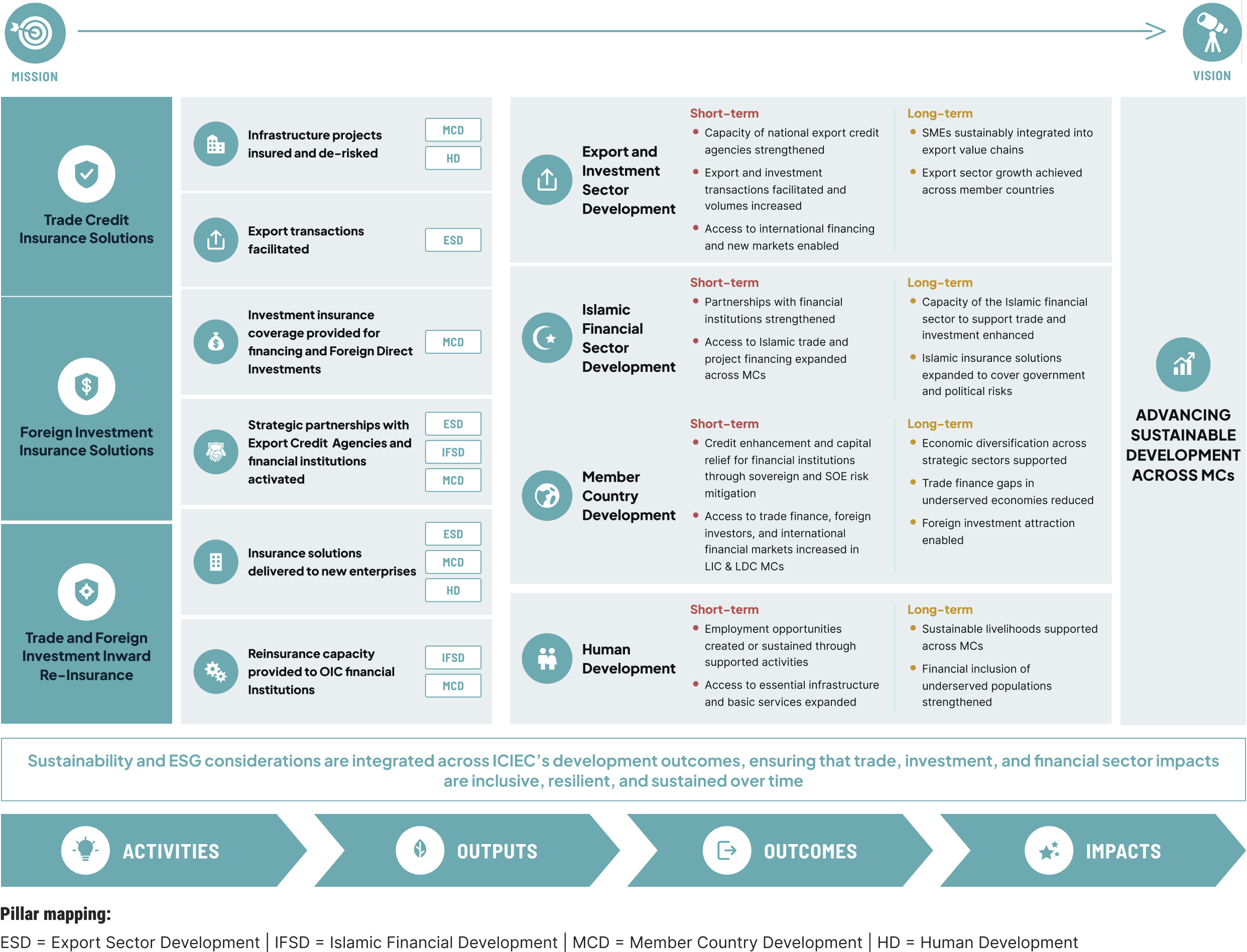
Building on ICIEC’s enhanced Theory of Change, the Corporation’s Development Effectiveness Framework provides the strategic structure through which it organises and assesses its development contribution across Member Countries.
It translates ICIEC’s mandate into four interconnected development pillars that reflect the primary pathways through which the Corporation’s risk mitigation solutions generate economic and social value.
Advancing Sustainable Development Across MCs
Export and Investment Sector Development
Short-term
- Capacity of national export credit agencies strengthened
- Export and investment transactions facilitated and volumes increased
- Access to international financing and new markets enabled
Long-term
- SMEs sustainably integrated into export value chains
- Export sector growth achieved across member countries
Islamic Financial Sector Development
Short-term
- Partnerships with financial institutions strengthened
- Access to Islamic trade and investment finance expanded
Long-term
- Capacity of financial sector to support trade and investment enhanced
Member Country Development
Short-term
- Investor confidence in MC markets strengthened
- Financing mobilised for strategic sectors
- Access to trade finance expanded in LIC & LDC MCs
Long-term
- Economic diversification across strategic sectors supported
- Trade finance gaps in underserved economies reduced
Human Development
Short-term
- Employment opportunities created or sustained through supported activities
- Access to essential infrastructure and basic services expanded
Long-term
- Sustainable livelihoods supported in priority sectors
- Financial inclusion of underserved populations strengthened
Sustainability and ESG considerations are integrated across ICIEC’s development pillars, ensuring that trade, investment, and financial sector impacts are inclusive, resilient, and sustained over time
Private resources mobilised through partnerships
OIC trade finance leveraged
Intra-OIC trade and investments promoted
Financial partnerships forged
Foreign Direct investments insured
Export transactions supported
Infrastructure development facilitated