Profile Interview Khurram Hilal

Standard Chartered signed a Non-Honouring of Sovereign Financial Obligation (NHSFO) agreement with ICIEC to fund a EUR103 million solar electrification project through the installation of 50,000 off-grid solar-powered streetlamps in rural areas across Senegal. Furthermore, Standard Chartered is also cooperating with ICIEC and Agrobank of Uzbekistan to bolster economic development in the central Asian country through Islamic financing products. This is expected to yield EUR150 million in support of SMEs in Uzbekistan. Can you expand on the rationale for this cooperation? How important is ESG, sustainability, energy transition and SME funding in your project pipelines and portfolios?

We have a longstanding relationship of working with ICIEC in transactions which have supported key priority sectors of Member States across Africa. Supporting ESG, sustainability, energy transition and SMEs is a key priority for Standard Chartered. Our rationale for supporting these transactions is our commitment to these markets, the developmental benefits of the transactions and our relationship with both the borrowers and ICIEC.
The Senegal transaction is a highly development project resulting in the electrification of remote villages where it is challenging to achieve electrification via traditional transmission lines. This project will directly facilitate increased economic activity and development in these regions. In addition, the social benefits will include improved quality of life and reduced crime. In relation to Agrobank of Uzbekistan the proceeds will be used for funding SMEs which will also have major development impact through supporting SMEs to expand, increasing employment and economic activity across the country.
We believe ICIEC is an ideal partner for cooperation in these transactions given its commitment to support such sustainable and developmental projects. In addition, ICIEC has a flexible approach and willingness to execute these transactions in a tight timeline. We would like to thank ICIEC for their cooperation which has contributed to the successful financial close of many such projects.
As ICIEC celebrates its 30th anniversary in 2024, its role as the only Shariah-based multilateral export credit and investment insurance provider continues to be crucial given that it has facilitated over USD108 billion in trade and investments, promoting growth, and development in its member states since its inception. The challenge is to upscale ICIEC’s operations and also to enhance the culture of credit and investment insurance in OIC member states. From the vista of a major international bank, with a history of involvement in the Islamic finance industry, how could this be achieved, especially in an era of rising uncertainties and geopolitical challenges?
We believe that there is a lot of opportunity for further collaboration with ICIEC to financing sustainable projects in member states. We see great potential across our footprint markets in Africa, Asia and the Middle East, which includes many ICIEC member states. Whilst most of our recent successes have been in Africa and most recently in Uzbekistan with the MoU signing, we are exploring further opportunities in many of the ICIEC member states including Türkiye, Pakistan, Malaysia, and Indonesia. In addition to supporting member states directly on sovereign financing, ICIEC is supporting on lending transactions to development banks in member states which has benefits beyond these countries.
“Supporting ESG, sustainability, energy transition and SMEs is a key priority for Standard Chartered. Our rationale for supporting these transactions is our commitment to these markets, the developmental benefits of the transactions and our relationship with both the borrowers and ICIEC.”

MEMBER COUNTRY PROFILE TÜRKIYE
A Resurgent Türkiye Riding the Crest of an Export Boom Beckoning Innovative Trade Finance and De-risking Solutions
Türkiye is riding the crest of an export boom. It’s just over 40 years since then Turkish Undersecretary of Treasury Turgut Ozal, who went on to become Prime Minister and then President of the Republic, urged Turkish business to “Export or Die.” The rationale was to emphasise the importance of trade and manufacturing to an economy. With greater exports comes greater demand for export finance, credit insurance and guarantees. According to official Turkish trade data released in January 2024, the country’s exports increased for a third consecutive year reaching USD255.8 billion in 2023, up by 0.6% year-on-year from the USD254 billion in 2022. Türkiye exported to an impressive 70 countries in the year. ICIEC and the IsDB Group has enjoyed very close relations with Türkiye and its various agencies especially Turk EXIM, the state ECA, corporates and banks. The IsDB Group has an important regional hub in Istanbul, where ICIEC also has a dedicated regional office. Last year for instance the Hub hosted a ground-breaking three-day immersive Workshop to explore the pivotal role of information sharing and business intelligence in supporting trade and investment decisions in the member states of the Organization of Islamic Cooperation (OIC). Fatma Gamze Sarioglu, Senior Country Manager for Türkiye at ICIEC, delves into the foundational policies and contemporary dynamics shaping Türkiye’s trade and economic landscape and examines the historical context of modern trade initiatives, the current export landscape, strategic international collaborations, the impact of digital transformation on the trade sector, and the potential for ICIEC’s Sukuk Insurance Policy in upscaling issuances.
The roots of modern Turkish trade policies can be traced back to the reforms initiated by then Prime Minister Turgut Ozal in the 1980s, who went on to become President of the Republic between 1989 to 1993. Ozal’s economic liberalization and pro-market reforms catalyzed Türkiye’s integration into the global economy, setting the stage for the contemporary economic strategies that drive the nation today. These foundational policies have not only enhanced Türkiye’s economic resilience but also its adaptability to global trade dynamics.
Current Export Landscape and Economic Growth
Recent data on Türkiye’s exports illustrate a robust trajectory of growth, underscored by a diversification in both products and export destinations. This continuous expansion is a testament to Türkiye’s strategic positioning and its ability to adapt to changing global market demands. The diversity of export destinations highlights the country’s extensive trade network and its pivotal role in regional and global supply chains.
In February 2024, Türkiye’s leading exports included a diverse range of high-value products. Automobiles, including cars, tractors, trucks, and related parts, topped the list with exports valued at USD2.62 billion. This was followed by machinery, mechanical appliances, and their parts, which brought in USD1.8 billion. Electrical machinery and electronics also featured prominently, generating USD1.12 billion in export revenue.
Additionally, the exports of iron and steel contributed USD890 million to the economy, while precious stones, metals, and pearls accounted for USD874 million. These figures underscore the breadth and diversity of Türkiye’s export sector, highlighting its capability to compete in various high-demand markets globally.
The notable increase in Türkiye’s year-onyear exports in 2024 was primarily driven by significant gains in key markets and product categories. Exports to Iraq surged by USD329 million or 53.3%, while exports to the United Kingdom and the United States rose by USD204 million (25.2%) and USD198 million (20.4%), respectively. Among products, automobiles— including cars, tractors, trucks, and their parts—saw an increase of USD445 million or 20.5%. Iron and steel exports grew by USD281 million or 46.1%, and mineral fuels, oils, and their products rose by USD227 million or 35.2%.
In terms of destination, Türkiye’s largest export markets in 2024 were Germany (USD1.56 billion), the United States (USD1.17 billion), Italy (USD1.08 billion), the United Kingdom (USD1.02 billion), and Iraq (USD945 million). On the import side, Türkiye’s major sources included Russia (USD3.97 billion), China (USD3.21 billion), Germany (USD2.05 billion), the rest of the world (USD1.53 billion), and Italy (USD1.37 billion). This robust trade activity highlights Türkiye’s dynamic engagement in international trade, balancing a diverse range of export products with strategic import relations to support its economic growth.
ICIEC’s Strategic Engagement in Türkiye
The Islamic Corporation for the Insurance of Investment and Export Credit (ICIEC) and the Islamic Development Bank (IsDB) Group have been instrumental in fostering trade and financial services in Türkiye through strategic partnerships with local entities like Turk EXIM Bank. These cooperative efforts are geared towards enhancing economic stability and facilitating sustainable development projects within the country.
Türkiye has established itself as a pivotal partner of ICIEC, fulfilling multiple roles as a shareholder, client, and collaborator. Since ICIEC began its operations in Türkiye, it has insured transactions totaling USD24.32 billion, underscoring the significant scale of its involvement in the Turkish market.
The establishment of the ICIEC office in Istanbul, Türkiye in 2015 marked a new era of enhanced cooperation, with exposure growing substantially. To date, ICIEC has provided insurance coverage for USD12.68 billion in exports from Türkiye and USD3.62 billion for the imports of strategic goods into the country.
Furthermore, the coverage extends to significant investments, insuring USD4.23 billion for foreign investments in Türkiye and USD3.77 billion for Turkish investments abroad. This support is critical not only for large enterprises but also for small and medium-sized enterprises (SMEs) through strategic partnerships with institutions like Turk Eximbank.
The impact of ICIEC’s local office in Türkiye is evident from the remarkable increase in the country’s exposure within ICIEC, which has escalated from USD217 million at the time of the office’s opening to USD1.45 billion today. This growth highlights the deepening relationship between Türkiye and ICIEC, and the significant role ICIEC plays in supporting the Turkish economy’s integration into global trade networks.
Turk Eximbank plays a crucial role as a strategic partner for ICIEC in Türkiye, effectively enhancing the support provided to the Turkish economy. The synergy between ICIEC and Turk Eximbank is manifest in several key areas:
- Reinsurance of Export Transactions: ICIEC provides reinsurance support for short to medium-term export transactions facilitated by Turk Eximbank, bolstering the latter’s capacity to back a larger volume and variety of export activities.
- Insurance of International Project Finance: ICIEC insures international project finance loans for Turkish contractors involved in significant projects in ICIEC member countries. Notable projects include the Douala Japoma Stadium in Cameroon, the Diamniadio Sports Arena, Cicad Business Hotel and Exhibition Center, and the Dakar Market and Truck Station – all in Senegal. This insurance coverage mitigates risks associated with overseas construction projects and enhances the competitiveness of Turkish contractors abroad.
-
Support for International Borrowing: ICIEC supports Turk Eximbank’s international borrowing efforts by insuring the risks associated with these financial activities. This insurance provision enhances Turk Eximbank’s ability to secure funding on favorable terms, thereby extending its capacity to support larger and more impactful projects.
Together, these collaborative efforts not only strengthen Turk Eximbank’s role in supporting Türkiye’s economic expansion but also solidify ICIEC’s impact as a complementary force in fostering secure and sustainable international trade and investment activities for Türkiye.
Innovative Projects and Regional Contributions
Türkiye’s commitment to sustainable and innovative development is evident in projects such as the Yerköy-Kayseri High-Speed Railway and various wind farm initiatives. These projects not only bolster regional connectivity and energy sustainability but also contribute significantly to the country’s economic growth and environmental goals.
ICIEC in late 2023 participated in a landmark Green Railway transaction through issuing a EUR134.1 million insurance cover for the Yerköy-Kayseri High-Speed Railway project in Türkiye, which is being built between Yerköy YHT Station in Yerköy District of Yozgat and Kayseri YHT Station in the Kocasinan District of Kayseri and which will be integrated with the Ankara-Sivas high-speed railway when completed. The cover was for a Syndicated Financing Facility led by MUFG Securities EMEA plc and comprising six 6 banks including MUFG, Banco Santander, DZ Bank, Deutsche Bank, Societe Generale and ING Bank.
Ensuring that ICIEC’s support remains robust and effective is crucial within Türkiye’s rapidly evolving economic landscape. This involves continuous adaptation to the changing needs and growth trajectories of the Turkish economy to maintain alignment with national development goals and global market dynamics. It is imperative to proactively address global economic challenges that could influence Türkiye’s trade and investment activities. This includes navigating disruptions in international trade, fluctuations in global markets, and geopolitical tensions, all of which can impact Türkiye’s economic stability and growth prospects.
In addition, there is a growing necessity to respond to the potential impacts of climate change on investments in Türkiye. This involves supporting the transition to a green economy by fostering investments in sustainable infrastructure, renewable energy, and environmentally friendly technologies. Such strategic initiatives not only mitigate the adverse effects of climate change but also position Türkiye as a leader in sustainable development, ensuring long-term economic resilience and environmental stewardship.
MEMBER COUNTRY PROFILE TÜRKIYE

The Promise of Sukuk and ICIEC’s Sukuk Insurance Policy
Türkiye’s is the fourth largest Sukuk issuer globally and among the three G20 countries active in the Sukuk market, according to Fitch Ratings’s latest Türkiye DCM Dashboard.
Sukuk rose to 15% of the 2023 Debt Capital Market (DCM) issuance (2018:6.2%), and 6.5% of DCM outstanding in 1Q24 (2021:4.7%). US dollar Sukuk issuers generally aim to comply with AAOIFI Sharia standards to not exclude UAE Islamic banks. In 2022, on back of the sovereign seeking alternative funding amidst weak investor demand, Sukuk peaked at 40% of US dollar DCM issues. The Turkish DCM rose 8% y-o-y to USD422.6 billion outstanding at end Q1 2024, with the majority in Turkish lira (63%), followed by US dollars (32%), and euros (5%). The recent revival in foreign-currency debt issuances is a sign of lower near-term refinancing risks due to improved investor sentiment since Türkiye’s adoption of more conventional macroeconomic policies and on the back of record export receipts.
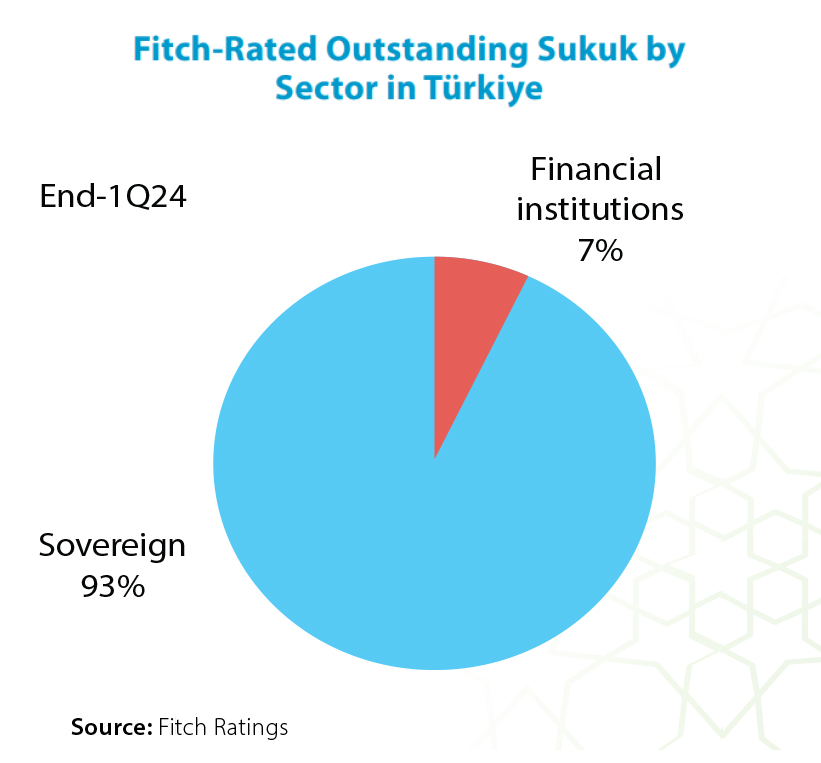
In March, Fitch upgraded Türkiye to ‘B+’/Positive. Fitch rates 90% of Turkish US dollar Sukuk (USD12.3 billion), with 93% rated ‘B+’.
According to Fitch’s Global Head of Islamic Finance, Bashar Al Natoor, there are signs of rated banks and corporates returning to the dollar debt market since 2H 2023, reflecting improved access and strategic moves to maintain their presence by locking in more acceptable, although still high, pricing, following a prolonged period of very limited issuance.
The reasons are clear – general low government debt, with a strong revenue base, manageable debt amortisations and improved financing conditions. Türkiye issued USD10 billion in external markets in 2023, and the current financing plan assumes a similar amount for 2024. The sovereign issued a USD3 billion conventional bond in February 2024 with the lowest spread of the past four years. In 2022, on back of the sovereign seeking alternative funding amidst weak investor demand, Sukuk peaked at 40% of the US dollar DCM. By Q1 2024, Lease certificates (Sukuk AlIjarah) accounted for 25.9% of fixed coupon Turkish lira-denominated issuances.
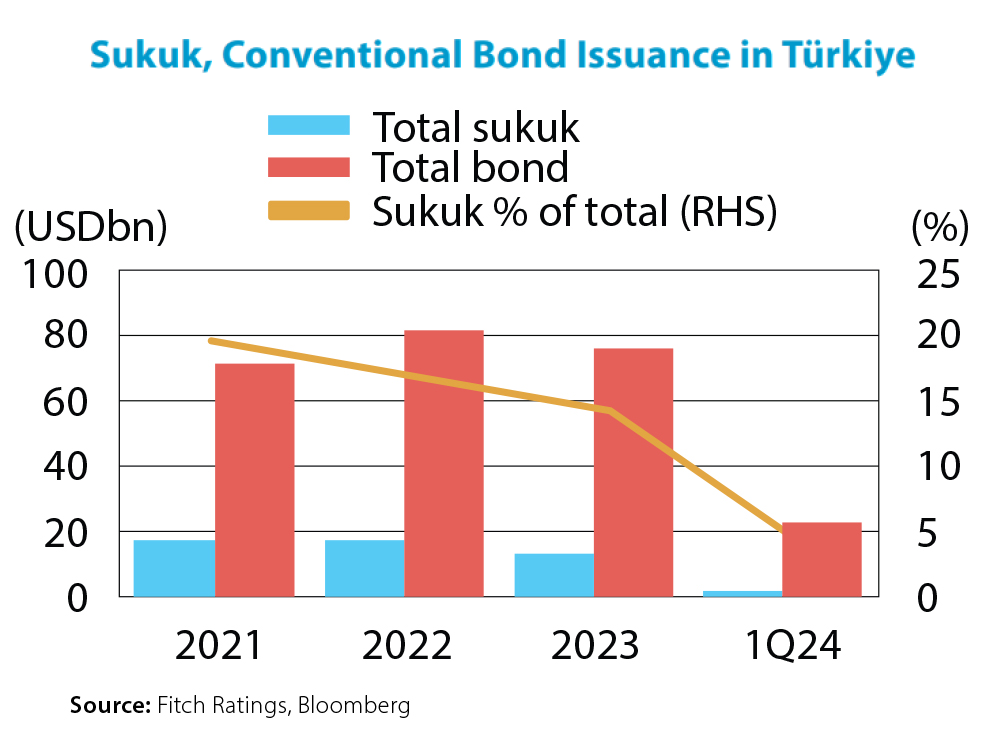
Despite the above, the Türkiye Sukuk market dynamics relative Saudi Arabia, Malaysia and the UAE has a low issuance base, and therefore a low critical mass of offerings and market depth. The involvement of bank and corporate issuers is also low. Here ICIEC’s Sukuk Insurance Policy could act as a vital facilitator/market maker especially for quasi-sovereign and other government-linked agency issuers.
The Turkish Treasury is a proactive issuer of lease certificates as part of a wider universe of government fund-raising instruments which include bonds and Sukuk – leasing certificates and bonds, FX denominated issuances and gold-backed certificates/bonds “in order to increase the domestic savings, broaden the investor base and diversify borrowing instruments.”
The Türkiye Treasury in fact raised TRY120,994.22 million (USD4,174.22 million) from the domestic market through the issuance of Fixed Rate Lease Certificate (Sukuk al Ijarah) in nine auctions in FY2023. Thus far for the first three months of 2024, the Türkiye Treasury has raised TRY2312,988.90 million (USD403.54 million) through three consecutive auctions of Fixed Rate Lease Certificates.
The Role of Digital Transformation in Türkiye’s Trade Sector
Digital transformation in Türkiye’s trade sector is pivotal in enhancing economic infrastructure and operational efficiency. The adoption of digital solutions in trade finance has streamlined processes, reduced costs, and improved security. The OBIC Workshop held in Istanbul in 2023 exemplified the importance of information sharing and business intelligence in supporting trade and investment decisions among OIC member states, highlighting the strategic use of digital technologies to foster a more integrated and efficient market environment.
Conclusion
Türkiye’s trade and economic landscape is characterized by a rich history of strategic policymaking, robust export growth, and innovative development projects. Through strategic international collaborations and a forward-looking approach to digital transformation, Türkiye is well-positioned to continue its economic growth trajectory and play a central role in the global economic arena.
Türkiye Treasury TRY Fixed Rate Lease Certificates 2023/24 to Date
| Date | Volume (TRY mns) | Tenor | Maturity Date | Fixed Rental Rate | Rental Payment Period |
|---|---|---|---|---|---|
| 25/01/2023 | TRY14,008.7 mn | 5 Years | 19/01/2028 | 4.79% | 6 months |
| 22/02/2023 | TRY9,946.00 mn | 5 Years | 16/02/2028 | 4.64% | 6 months |
| 08/03/2023 | TRY5,413.00 mn | 10 Years | 23/02/2033 | 5.71% | 6 months |
| 21/06/2023 | TRY12,086.00 mn | 5 Years | 14/06/2028 | 8.62% | 6 months |
| 08/08/2023 | TRY27,148.00 mn | 5 Years | 02/08/2028 | 9.79% | 6 months |
| 09/09/2023 | TRY12,373.00 mn | 10 Years | 07/09/2033 | 13.19% | 6 months |
| 18/10/2023 | TRY28,927.23 mn | 5 Years | 11/10/2028 | 14.26% | 6 months |
| 15/11/2023 | TRY3,566.90 mn | 5 Years | 08/11/2028 | 16.48% | 6 months |
| 13/12/2023 | TRY10,000.00 mn | 5 Years | 08/12/2028 | 14.28% | 6 months |
| 24/01/2024 | TRY5,856.10 mn | 5 Years | 17/01/2029 | 14.34% | 6 months |
| 21/02/2024 | TRY3,569.50 mn | 5 Years | 14/02/2029 | 13.79% | 6 months |
| 20/03/2024 | TRY3,562.30 mn | 5 Years | 14/03/2029 | 15.00% | 6 months |
ICIEC is committed to advancing its support for Türkiye’s development through a multifaceted strategy that emphasizes critical infrastructure, innovative financial products, and sustainable development. These include:
- Support for Critical Infrastructure: ICIEC plans to continue its robust backing of vital infrastructure projects within Türkiye, focusing on sectors such as transportation, energy, and telecommunications. These efforts are crucial for enhancing the nation’s economic foundations and connectivity.
- Innovation in Financial Products: With the introduction of Sukuk insurance products, ICIEC aims to propel the growth of Islamic finance, especially fixed income capital market debt products. This initiative is designed to attract global investors by providing secure, Shariah-compliant investment opportunities, thereby broadening the financial landscape in Türkiye.
- Environmental Sustainability and PPPs: ICIEC will actively promote environmentally sustainable projects while encouraging the formation of Public-Private Partnerships (PPPs). These endeavors are intended to leverage private sector efficiencies and foster investments that are not only economically viable but also environmentally responsible.
- Mobilization of Private Sector Capital: By acting as a catalyst for mobilizing private sector capital towards Sustainable Development Goals (SDGs), ICIEC aims to contribute significantly to global efforts in achieving these targets. This strategic focus is expected to support sustainable economic growth and social development.
- Expansion into Africa: Reflecting Türkiye’s strategic interests, ICIEC is poised to increase its active involvement in Africa. Upcoming projects on the continent will benefit from ICIEC’s expertise and support, aligning with Türkiye’s broader geopolitical and economic objectives.
Through these strategic initiatives, ICIEC not only reinforces its commitment to supporting Türkiye’s economic trajectory but also aligns its operations with broader global standards and development goals, ensuring a sustainable and prosperous future.
Mainstreaming Affordable Credit Insurance in ICIEC Member States
Upscaling Critical Mass, Market Depth and Awareness Amid Rising Risks
The 57 and 49 member states of the IsDB and ICIEC respectively could benefit from an enhanced credit and investment insurance culture and ecosystem. This pertains to the structural, policy, resource, organizational capacity realities of the industry across the spectrum – government agencies, insurers and underwriters to peer institutions, to financial sector entities, to corporates and businesses, and to SMEs. Mushtak Parker considers the challenge of how to mainstream risk mitigation and credit enhancement through increasing the provision of affordable credit and investment insurance in member states, and how ICIEC can play an enhanced market maker role in this respect through partnerships, market education and collaboration both at a national level and with international industry bodies and linkages.
Malaysian Prime Minister Anwar Ibrahim has repeatedly flagged up in recent months the vital trade finance and insurance sector. Whether at the Global Forum on Islamic Economics and Finance (GFIEF) in Kuala Lumpur on 28- 29 May 2024, at the IsDB Annual Meetings in May in Riyadh, and at the 15th International Conference on Islamic Economics and Finance in February 2024 in Kuala Lumpur, the Prime Minister has been calling for the adoption of a reformist holistic agenda to help mitigate the huge socio-economic, trade and investment challenges and opportunities faced by the 57 member states of the Organization of Islamic Cooperation (OIC) and its development finance organ, the Islamic Development Bank (IsDB).
Islamic trade finance is estimated to account for less than 5% of total trade finance in OIC member states. Reliable data is fragmented, underdeveloped, and often dated because of poor disclosure and lack of transparency.
The fact that intra-OIC trade and investment has not even hit 25% of their total exports and imports and FDI flows, indicates the uphill struggle for Member States to upscale their bilateral and multilateral trade and investment flows.
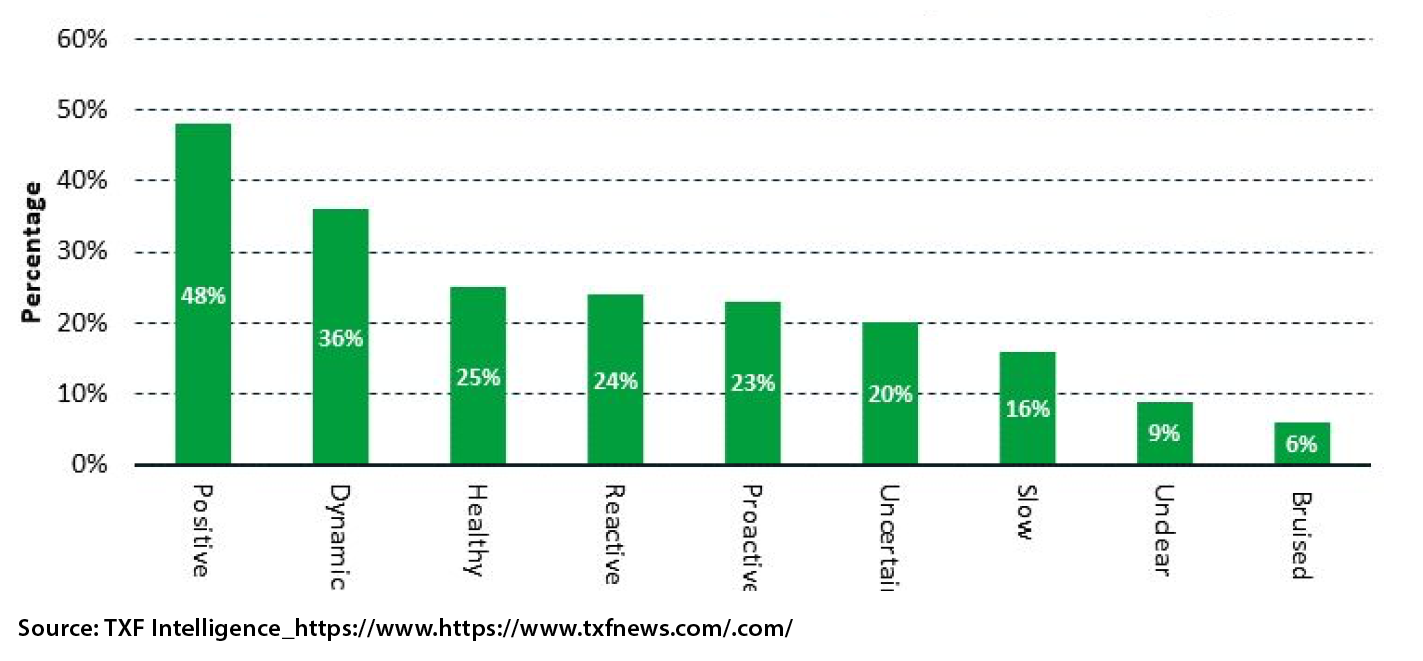
Globally market sentiments for export finance and credit and investment insurance in general is positive as the impacts of the COVID-19 pandemic continue to recede although still impacted by the supply chain disruptions of the conflict in Ukraine, the subdued resultant global economic recovery marked by low GDP growth, stubbornly high inflation rates, high interest rates, rising sovereign debt burden of Lower-Middle Income Countries (LMICs), and the ensuing global cost of living crisis. The TXF Export Finance Survey in June 2024 confirms the positivity of the export finance market although the sentiments have yet to be fully absorbed into the market operations.
What best describes the current state of the export finance industry?
A Reform Agenda for the Islamic Economy
“As we navigate the complexities and uncertainties of these post-normal times,” emphasized PM Ibrahim, “the principles of Islamic economics and finance remain even more relevant to resolve the core conundrums which the world is facing. These include lifting abject poverty, ensuring food security, mitigating climate change, and enabling equal opportunity to comprehensive education. This is why we must embark on a holistic ‘Islah’, a reform agenda for positive change and a force for good in the global economy.”
The Islamic finance ecosystem, he reiterated, needs to evolve progressively, placing greater emphasis on value-based sustainable finance, transcending the profit-driven motives or to embrace a higher purpose where wealth is not just accumulated among the few but circulated to uplift communities, protect the environment, and investment carries a balanced promise of prosperity. In Riyadh for instance, the Malaysian Ministry of Finance, Bank Negara Malaysia (BNM), the central bank, the IsDB and the World Bank, unveiled a collaborative “new blended finance innovation” – a pilot programme on greening Halal businesses. The aim is to assist halal businesses in Malaysia and elsewhere to transition to greener and sustainable practices by providing technical capacity building, tools to measure and report greenhouse gas emissions, derisking and credit enhancement solutions in trade and investment, and transition financing including certifications.
According to the ICIEC 2023 Annual Report, while 2021 marked a zenith for intra-OIC imports at USD436.0 billion, a subsequent contraction to USD365.4 billion in 2022 raises questions about the internal trade synergies and potential barriers within the OIC ecosystem. The dynamics for intra-OIC exports reflected the same trend. The retraction, however, is almost certainly due to the pandemic, the supply chain disruptions caused by the Ukraine conflict and the sluggish global economic recovery.
Prime Minister Ibrahim is right in calling for greater focus to enhance the efficiency and transparency across the end-to-end supply chain in the potentially multi-trillion-dollar Halal economy. However, the dissonance between the wider Halal economy and the estimated USD3.5 trillion Islamic finance industry is stark albeit improving incrementally. However, there is an urgent need to upscale independent reliable research and data disclosure to better inform both policy makers and the spectrum of stakeholders in the trade, investment, finance and insurance value chain.
Vanilla Murabaha, Murabaha Syndications, Tawarruq (Commodity Murabaha) and Instalment Sale, and Trade and Investment Takaful, estimated at almost USD1trillion per annum, are established Islamic trade finance and insurance contracts across the market segments and in the various hybrid Sukuk structures. They are internationally accepted mainstream trade finance products which have been accessed even by major Western, Japanese, and South Korean multinationals.
According to Dinar Standard, OIC imports are projected to reach USD3.43 trillion by 2027, while OIC exports are projected at USD4.30 trillion – indicating huge potential for credit and investment re/insurance.
The State of the Islamic Trade and Investment Insurance Market
Reliable data relating to what extent Islamic trade finance and insurance is directed to the Halal economy is simply not available. A senior official from Malaysia’s Halal Development Corporation attending a major Halal convention in London recently agreed that the global industry does have a major bottleneck in reliable and up-to-date data and research in various aspects of the value chain, including the connectivity to the Islamic finance industry.
The reality remains that while Export Credit Agencies (ECAs) and multilateral insurers, such as ICIEC, in AMAN UNION member states have generally witnessed some growth in their operations – both conventional and Shariahcompliant – largely linked to government COVID-19 mitigation emergency packages, the reality is that the culture of credit and political risk insurance (PRI) in many OIC markets remains underdeveloped. The AMAN UNION is the forum comprising Commercial and Noncommercial Risks Insurers and Reinsurers in OIC member states and of the Arab Investment and Export Credit Guarantee Corporation (DHAMAN).) ICIEC is responsible for the administration of the AMAN UNION.
Part of the problem is lack of market awareness and of a comprehensive strategy to promote and connect trade and investment Takaful to the spectrum of economic activity and market segments – trade, investment, commerce, export promotion, imports, infrastructure projects and even financial products such as Sukuk origination, housing and mortgage securitization, especially in an era of everevolving new risks. When Takaful is discussed or researched it is almost routinely confined to family and general Takaful. Credit and PRI Takaful is almost completely off the radar. This also connects with the underdeveloped state of financial journalism in member states. Yet in sheer volume and value terms, the latter is infinitely bigger as a market segment than family and general Takaful.
The perception rightly or wrongly remains that credit and investment insurance is an extra unnecessary cost, where often the premiums are prohibitive especially for companies and clients in the low-and-mediumincome-countries (LMICs), and the requisite government policy and regulatory frameworks are either not in place or underdeveloped to make transactions and projects bankable especially for the involvement of much-needed private sector capital and financing.
Towards an OIC Trade Insurance Master Plan
ICIEC, which marks its 30th anniversary this year and uniquely the only Shariah-compliant multilateral insurer in the world, has almost single-handedly shown the viability, efficacy, market potential and importance of trade and investment Takaful and Re-Takaful for OIC economies. The proof is in the pudding. The Corporation has cumulatively insured business to date surpassing USD114 billion since it started operations in 1995, comprising USD90.7billion in export credit insurance and USD23.3billion in investment insurance. ICIEC has also underwritten policies since inception totaling USD53.6 billion in support of intra-OIC trade and intra-investment.
There are several challenges ahead for the Shariah-compliant trade and investment insurance market. The main one is the lack of dedicated private Shariah-compliant providers. The architecture currently comprises ICIEC as the only Shariah-compliant multilateral insurer and a number of ECAs and private providers.
An analysis done last year by Turk Eximbank showed that the total capital base of AMAN UNION member entities was a mere USD13.6 billion at end 2021 – up on the USD10 billion in 2020, of which Saudi EXIM accounted for 59% in 2021. Total AMAN UNION Business Insured in 2021 reached a mere USD49 billion – up 17% on 2020, of which the top 5 members accounted for 83% of total business insured, led by Turk Eximbank at 48% and ICIEC at 20%.
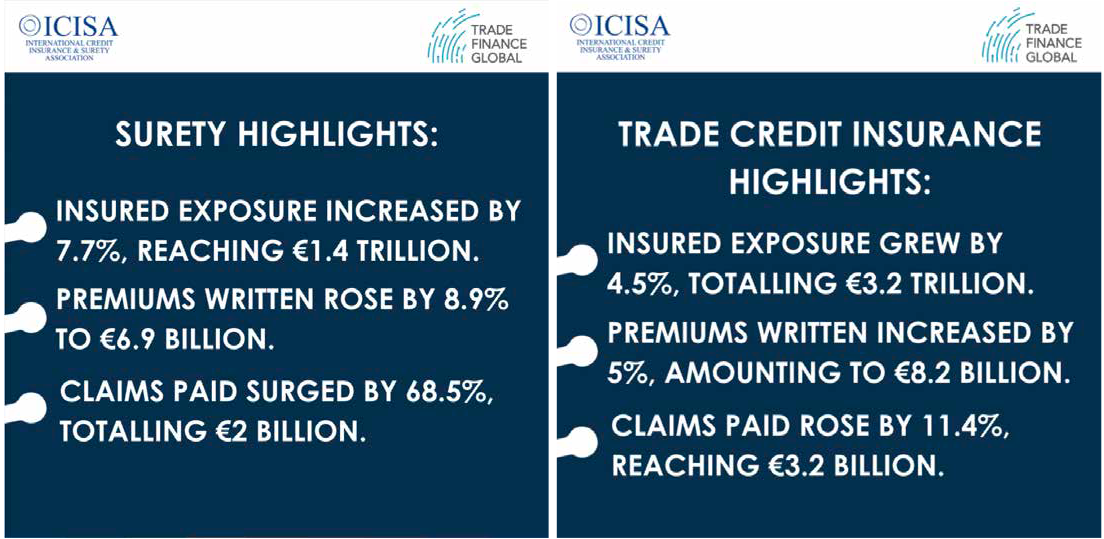
In contrast, members of the International Credit Insurance and Surety Association (ICISA), the leading industry trade association representing trade credit insurance and surety companies internationally who account for 95% of the world’s private credit insurance business, insured nearly EUR3.2 trillion (USD3.43 trillion) in trade receivables insured and billions in infrastructure guarantees in 2023 – up 4.5% YoY. According to the latest data from ICISA, premiums written in 2023 increased by 5% to EUR8.2 billion (USD8.79 billion), while claims paid increased by 11.4% reaching EUR3.2 billion (USD3.43 billion).
According to the 2023 ICISA Annual Report, throughout 2023, ICISA members reported strong business growth despite a notable rise in claims across various lines. These trends are reflective of the ongoing volatility of macroeconomic conditions.
“Despite these challenges, the industry continued to provide a safe harbour for trade and investment in the real economy while remaining robustly capitalized. Demand for protection in the face of economic headwinds understandably grew throughout 2023 for both trade credit insurance and surety markets,” said ICISA President, Benoît des Cressonnières.
However, the macro risk environment, warns ICISA, “remains volatile and uncertain. Businesses face significant challenges due to high interest rates, rising costs, the energy transition, and disruptions from conflicts and geopolitical tensions. Trade continues to drive positive economic development, but managing associated risks and financing costs is increasingly challenging. While central banks look to carefully loosen monetary policy in the coming months, ICISA members expect challenging market conditions to persist in the short term.”
Not surprisingly, against this backdrop, surety claims rose significantly from 2022 to 2023, with EUR2 billion paid out in 2023, marking a 68.5% increase. Trade credit insurance members paid out EUR 3.2 billion in claims across the same period. This was up from EUR 2.7 billion in 2022, providing a valuable lifeline to businesses worldwide.
Similarly, the latest data from The Berne Union (International Union of Credit and Investment Insurers), the not-for-profit professional association representing the global credit and political risk insurance industry, shows that 2023 was an encouraging year for export credit with members providing over USD3 trillion in new support for cross-border trade, with expansion across almost all business lines, which augurs well for 2024 and beyond.
The reality however is that the gap between the conventional and Islamic credit insurance providers in almost every aspect is stark and has cost the OIC countries billions of dollars in opportunity costs lost especially because of the lack of Shariah-compliant opportunities for their economies in general and the Halal economy specifically.
The Great Leap Forward
Looking ahead, policy proposition, prioritization, upscaling, synergizing and implementation, together with smart collaboration, must be the order for the next few years if Shariah-compliant credit and investment insurance is going to take that great green leap forward in its involvement in the development agendas of member states.
In the meantime, there are several collaborations which if maximized to their full potential could go a long way towards the eventual mainstreaming of Shariah-compliant trade and investment insurance as an alternative option for government and commercial entities in OIC member states. The Joint Strategic Collaboration signed in April 2024 between ICISA and the AMAN UNION, for instance, is a potential gamechanger in enhancing the culture and business of trade and investment insurance in ICIEC Member States.
The collaboration underscores a shared commitment to advancing the trade and investment insurance landscape, particularly within OIC Member States. By sharing their respective expertise and networks, the parties aim to facilitate enhanced knowledge exchanges and initiatives that contribute to the sustainable development of OIC Member States. Key highlights of the Joint Strategic Collaboration include: i) Facilitating knowledge exchanges on trade and investment insurance initiatives, ii) Enhancing collaboration and development of best practices in the industry. Iii) Strengthening mutual relationships among members of both associations.
Mr. Richard Wulff, Executive Director of ICISA and Mr. Oussama Kaissi, then Secretary-General of AMAN UNION and CEO of ICIEC, recognize the significant potential for cooperation to drive positive outcomes in the trade and investment insurance sector. “Through this strategic alliance, we are assured to unlock unprecedented opportunities and drive innovation within our respective spheres. The signing of this MoU signifies a transformative leap towards harmonizing our efforts and maximizing the potential for sustainable growth and prosperity on a global scale. By pooling our resources and expertise, we can drive positive change and sustainable growth for our member states,” they maintained.
Similarly, another important development is the accession of The Islamic Development Bank (IsDB) and ICIEC to the International Renewable Energy Agency (IRENA’s) Energy Transition Accelerator Financing Platform (ETAF) in December 2023 to which they have also pledged USD250 million to projects on the platform by 2030 and to provide de-risking tools to support renewable energy projects in member developing countries.
Through the ETAF Platform, a multi-stakeholder climate finance solution managed by IRENA, ICIEC will provide credit and political risk insurance solutions to support the financing of renewable energy projects recommended by IRENA for the benefit of common member states. This partnership says ICIEC leverages its expertise in credit and political risk insurance and its synergies with the broader reinsurance market and focuses on advancing just, affordable and clean energy transition in LMICs. LMICs form the largest component of the 57 member states of the IsDB and are disproportionately affected by the ravages of climate devastation even though as a group they are the lowest emitters of carbon in the world.
As such, energy transition is not only a financial, economic, technological, survival and societal imperative, but also a moral one. As part of a diverse network of partners, the ETAF Platform enables the financing of renewable energy projects giving developers access to a suite of de-risking solutions and manifold financing opportunities as a way of advancing their energy projects and making them bankable to donors, institutional and private investors.
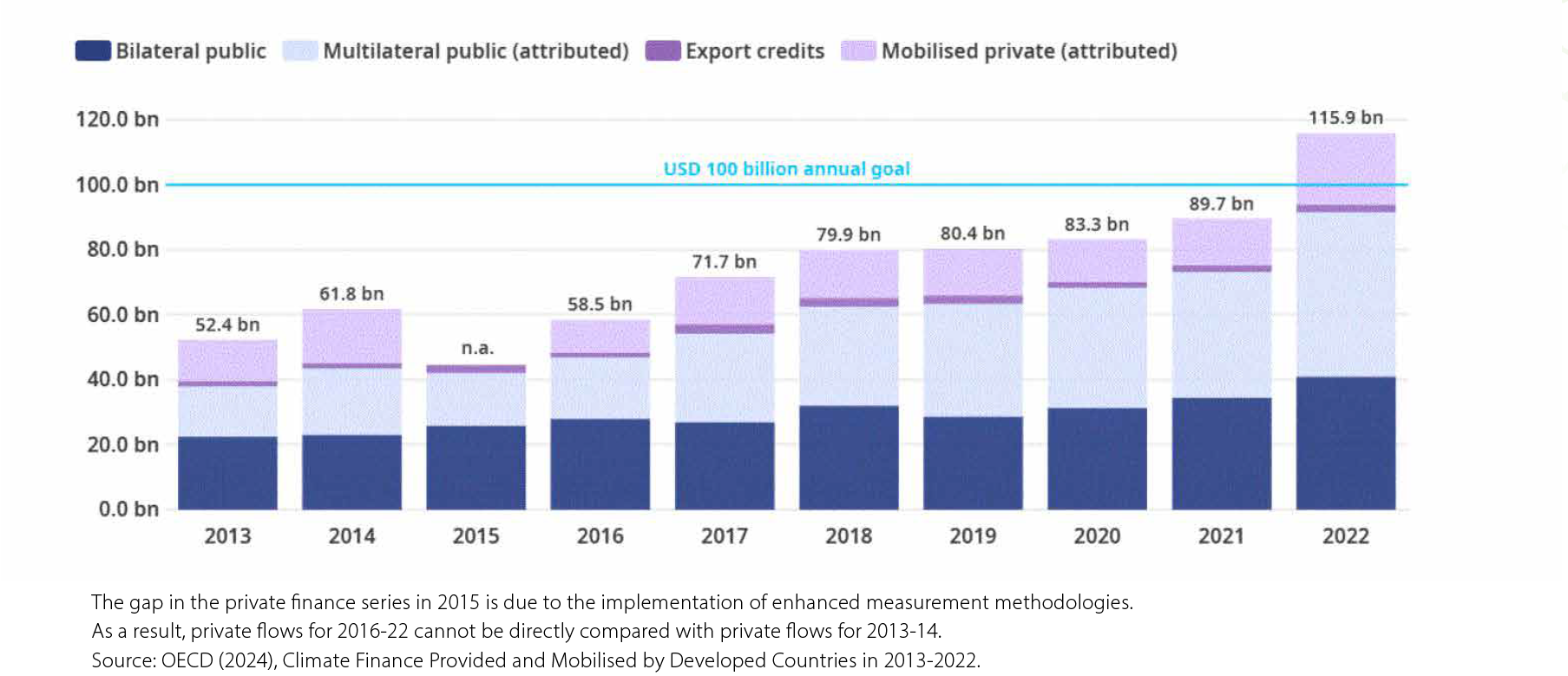
Climate finance for developing countries
Amounts provided and mobilised by developed countries, billion USD
Another interesting development is the growing interest by ECAs from non-OIC countries in using Shariah-compliant credit and investment insurance to support their exports and FDI investments to OIC markets especially in the MENA Region and Southeast Asia.
In June 2024, Italian State Export Credit Agency SACE Guaranteed its First-of-its-kind “Substantive” Commodity Murabaha Facility Provided by HSBC to UAE Food Giant, IFFCO, under its Push Programme to support Italian food and beverage value chain and exports to the Middle.
For the first time globally, SACE has guaranteed financing with an Islamic finance structure in favour of the IFFCO Group in the UAE. According to Michal Ron, Chief International Officer of SACE, “we secured financing with an Islamic financing structure (Murabaha Al Siala) for IFFCO Group, with HSBC as the sole participant. We agree that this operation will open numerous other opportunities for Italian SMEs in their respective sectors of interest. This is the first Push Strategy operation structured according to Islamic finance principles, which will enable the opening of new markets in the Middle East and other geographies, with a positive impact on Italian exports.”
IFFCO and HSBC both stressed that creating a “global first” Islamic structure under SACE’s Push Programme “exemplified designing a creative financial structure working around complex parameters to synchronize ECA clauses to fit into an Islamic structure to deliver an innovative solution versus conventional offering.”
Alexei Rybakov, HSBC’s Head of Export Finance for MENAT, sees the transaction potentially boosting Euro-Middle East trade using Islamic finance solutions. “This transaction,” he explained, “marks a further development in Sharia’h compliant structures. Innovative cross-border transactions like this are accelerating trade and investment between Europe and the Middle East. This collaboration between IFFCO, SACE, and HSBC has resulted in a ready templated solution to execute Shariahcompliant ECA financing under SACE’s Push Programme.”
The Slowing FDI Flow Rate
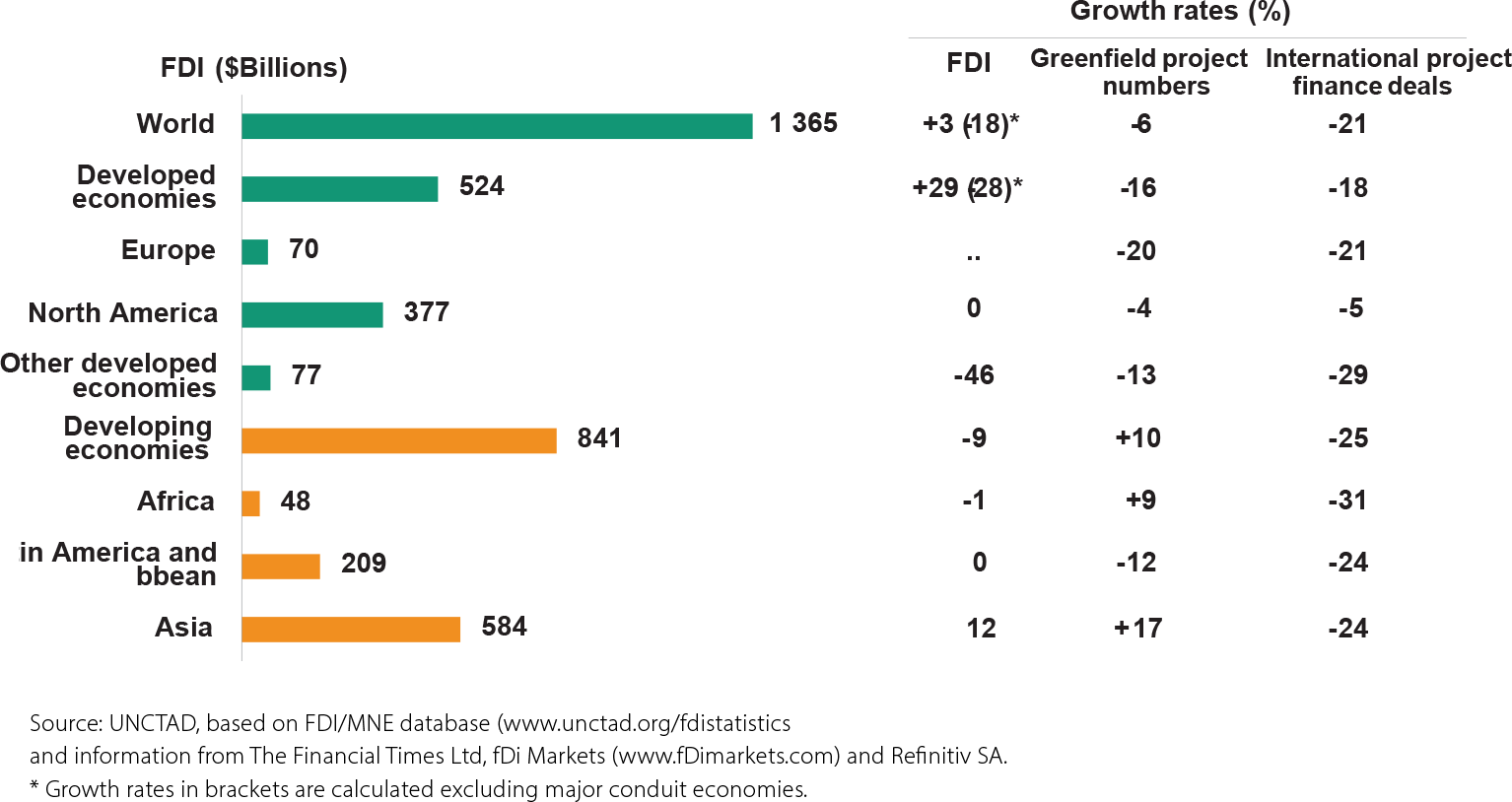
Global Foreign Direct Investment (FDI) flows, totalled an estimated USD1.37 trillion in 2023 according to the latest figures from UN Trade and Investment (UNCTAD’s) Investment Trends Monitor. This was a marginal 3% increase over 2022, defying expectations as recession fears early in the year receded and financial markets performed well. However, says UNCTAD, economic uncertainty and higher interest rates did affect global investment. FDI flows to developing countries disconcertingly fell by 9%, to USD841 billion, with declining or stagnating flows in most regions. FDI decreased by 12% in developing Asia and by 1% in Africa, here the bulk of IsDB and ICIEC member states are located.
In West Asia, FDI remained stable at 2% due to continued buoyant investment in the UAE, which saw greenfield announcements rise by 28% to the second highest number after the United States. Greenfield numbers also jumped in Saudi Arabia, by 63%.
FDI flows to Africa were almost flat at an estimated USD48 billion. Greenfield project announcements increased, mostly due to strong growth in Morocco, Kenya, and Nigeria. However, project finance deals fell by one third, more than the global average decline, weakening prospects for infrastructure finance flows, which merely highlights the growing need for project related underwriting and guarantees.
Investment trends by region, 2023 vs 2022
The importance of credit and investment insurance cannot be overstated. For an industry that has been around for over a century, the challenge ahead is to enhance awareness and market education among policy makers; regulators; multilateral, national and private sector insurers, and export credit agencies (ECAs); banking institutions, insurance providers, exporters, importers, investors, and SMEs. Today, according to the Berne Union’s Credit Insurance: Impact on Trade, Finance and the Real Economy report, around 90% of all global trade relies on some form of credit, insurance or guarantees, issued by a bank, insurer, or specialist financial institution. As it has done for over a century, the credit insurance industry will continue to evolve and adapt to meet challenges – societal, environmental, and economic – that lie ahead and support the real economy.
Credit and investment insurance typically acts as a catalyst that provides financing to the real economy through export and import flows and promotes foreign direct investment (FDI) movements across the globe. By protecting exporters and banks against the risk of non-payment, defaults and expropriation, credit insurance enables cross-border trade and investment. Perhaps this is a core challenge which industry bodies and countries in which Islamic finance is of systemic importance must embrace in how to upscale such cover dramatically both nationally, regionally and in the world of Islamic finance.
This against the background of risks and uncertainties in the global economic landscape. The latest SONAR Report published in June 2024 from the Swiss Re Institute, published since 2013, is indeed sobering – featuring 13 emerging risk themes and three trend spotlights. The emerging risk themes are what could be new or changing risks, with both up-and downside potential for insurers. The “trend spotlight” items highlight contextual developments SRI deems relevant for the industry, without necessarily profiling a specific risk.
Embracing Growing Opportunities for Credit Insurance and PRI in Uncertain Times

“In 2023, the export credit industry saw over USD3 trillion in new support, with a 40% increase in MLT business and record renewable energy commitments. The strong growth promises a positive outlook for 2024 and beyond.”
The trade and credit and credit insurance universe are in flux with potentially game changing developments over the next two years, which governments, international gatekeeper organisations, multilateral and private insurers, export credit agencies, financial institutions and the export/import fraternity would ignore at their peril. These include trade digitalisation, transitioning to ISO 20022, embedding Climate and ESG considerations in the trade playbook, the adoption of Electronic Trade Documentation, the implications of the Net-Zero Export Credit Agencies Alliance (NZECA) launched at COP28, and advancing the role of women in credit insurance. Dr. Khalid Khalafalla, Officer-in-Charge, ICIEC explores the above structural regulatory trends and initiatives for the credit and PRI industry.
It is not surprising that the Berne Union (BU) Spring Meeting in Oslo in April 2024 focussed on innovation in its various forms – covering topics ranging from technology to new and innovative products and how the export credit insurance industry is adapting to a swiftly changing global environment.
The export credit industry, says the Union, emerged from the pandemic strong with substantial growth in support provided for cross-border trade and investment as members ramp up commitments across key sectors and geographies. In fact, 2023 was an encouraging year for export credit with BU members providing over USD3 trillion in new support for cross-border trade, with expansion across almost all business lines, which augurs well for 2024 and beyond. The overall performance metrics for the industry in 2023 include:
- A 40% increase to over USD165 billion for MLT business, following strong growth in manufacturing, infrastructure, and transport sectors alongside a continuing rapid growth in renewable energy investments.
- A particularly strong year for ECAs who grew their MLT business by 50% following several years of relative stagnation throughout the pandemic. Private CPRI underwriters continue to build on the strong year-on-year growth they have recorded since 2020.
- The industry is drawing upon an increasingly flexible product suite with volumes of untied credit support increasing 30% to over USD50 billion in new commitments in 2023.
- Climate and the green transition are the main drivers of new opportunities with a record USD20.5 billion in reported new commitments for renewable energy across 68 countries in 2023.
- BU members provided an estimated USD98 billion in total support for wider green, climate and energy-transition related transactions in 2023 – 5 times the commitments to renewable energy production alone and a significant portion of total long-term finance supported across MLT and PRI business.
- Members are attuned to a heightened political risk environment, with both sovereign defaults and corporate insolvencies driving an uptick in claims. Over USD9 billion of claims were paid, with a significant spike in MLT political risk claims in FY 2023 largely due to a distressed period for sovereign debt.
- Geopolitical risk and armed conflict have become an increasing concern for members.
- ST claims continued to rise along with insolvencies, with levels manageable. MLT commercial claims continued to fall with strong recoveries in the transport sector.
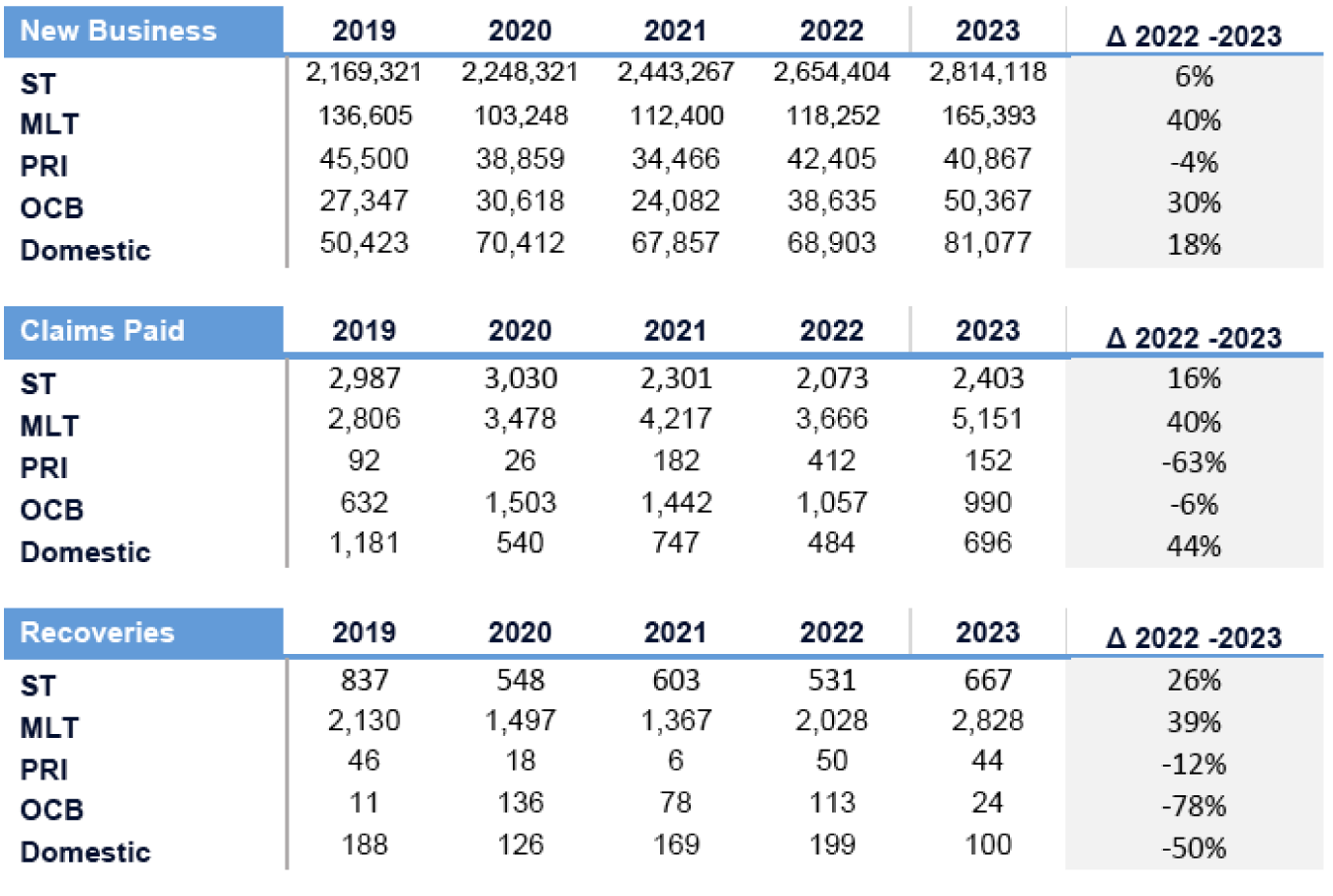
ST: Short Term Export Credit – Export Credit / Trade-Finance Credit lending and Insurance of which the repayment term is less than 360 days.
MLT: Medium / Long-Term Export Credit – Insurance, Guarantees and lending for Export/Trade-Finance Credit of which the repayment term is greater than 360 days.
PRI: Political Risk Insurance – Insurance or Guarantee that indemnifies an equity investor or a bank financing the equity investment for losses incurred to a cross-border investment as a result of political risks.
OCB: Other Cross-border Credit – Insurance or Guarantee or direct loan relating to a debt-finance instrument, of which the debt obligor resides in a different country than the debt counterparty, AND the debt obligation is provided without any requirement that the debt capital be used to finance an export or international trade.
The key takeaways could not be clearer – the macro risk environment remains volatile and full of uncertainty, with businesses challenged by elevated interest rates and increased costs as well as pressures around energy transition and disruption emerging from both direct conflict and wider geopolitical tensions. Trade remains one of the most powerful tools for promoting positive economic development and although it continues to grow, the risks and costs of financing this are increasingly challenging, and the technology and innovation needed to deliver a climate transition in line with the goals of the Paris Agreement requires huge volumes of finance from both public and private sources.
Berne Union Business Confidence Survey, 1st Quarter 2024
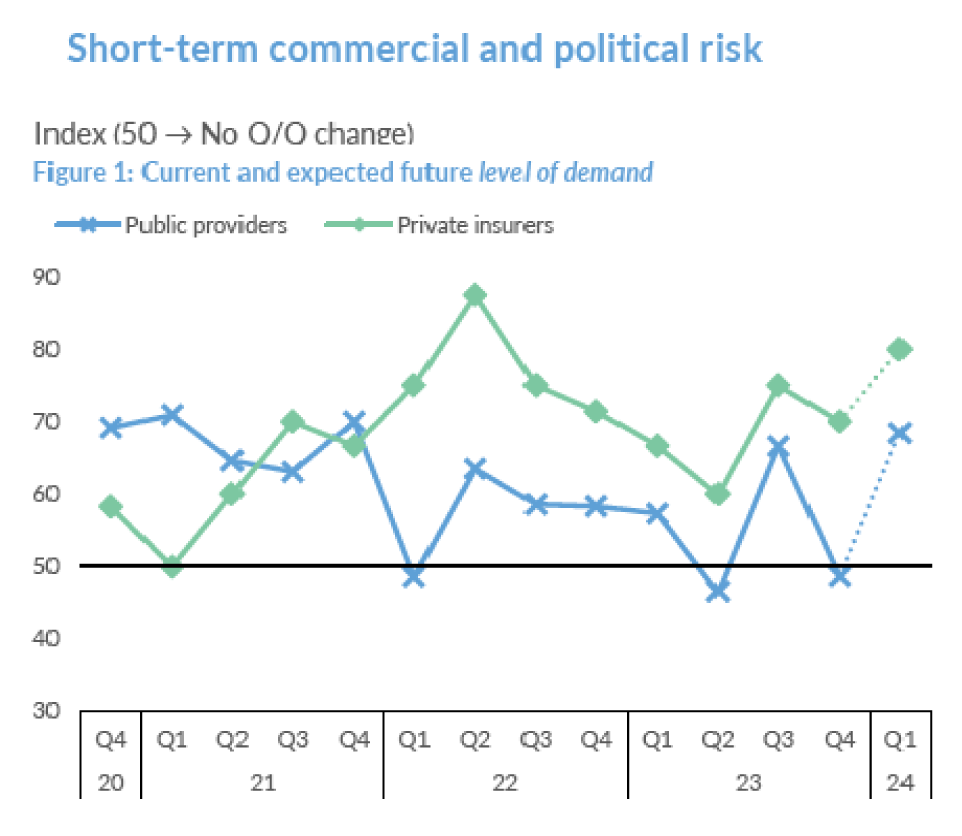
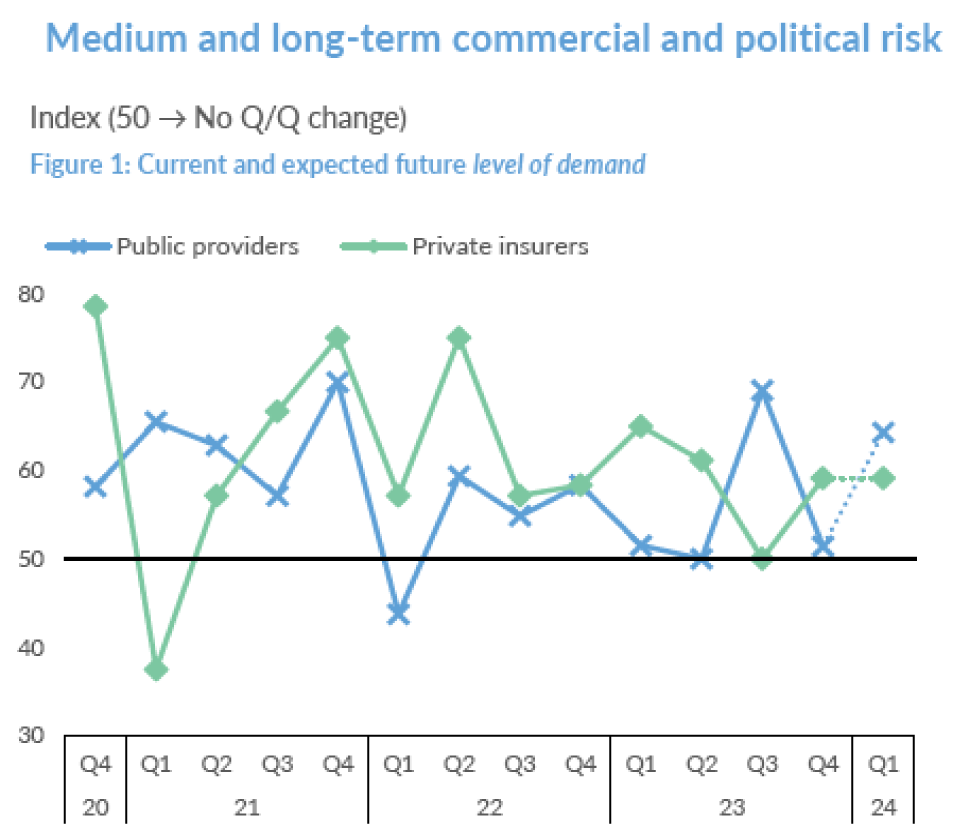
That the export credit insurance industry is well placed to play an important role in tackling the above challenges – not only mitigating trade risks and unlocking finance, but also in helping guide economic transformation and supporting green supply chains – is not in doubt.
Opportunities and Risks
The table below clearly identifies the perceptions of BU members about the opportunities and risks for export credit and PRI business in 2024 and beyond with Green and transition projects, renewable energy, new supply chains and markets, SME support, and innovative risk-sharing structures the top priorities. This is against the top risk perceptions of geopolitical tensions, global economic slowdown, conflicts, emerging markets sovereign debt crises, and high interest rates.
Greatest Opportunities and Risks for Export Credit and PRI Industry in 2024
| Greatest Opportunities | |
|---|---|
| 1 | Green/Transition (Excluding Renewables) |
| 2 | Renewable Energy |
| 3 | New Supply Chains/Markets |
| 4 | SME Support |
| 5 | Innovative Risk-Sharing Structures |
| 6 | Energy Sector Investment |
| 7 | Blended Finance |
| 8 | Digital Transformation (Including AI) |
| 9 | New Financial Products |
| 10 | New Technologies in Goods and Services |
| 11 | Recommencement of Paused Projects |
| 12 | Alternative Capital |
| Greatest Risks | |
|---|---|
| 1 | Geopolitical Risk |
| 2 | Global Economic Slowdown/Recession |
| 3 | Impact of Conflicts |
| 4 | Emerging Market Debt Crises |
| 5 | High Interest Rates |
| 6 | High Inflation (or Deflation) |
| 7 | Rising Barriers to Trade |
| 8 | Corporate Leverage/Liquidity |
| 9 | Energy Market Disruption |
| 10 | Negative Impacts of Regulation |
| 11 | Commodity Volatility |
| 12 | Physical Climate Risks |
An important initiative that emerged out of COP28 in Dubai could potentially be a game changer in the role and ways de-risking solutions are contributing to the Net Zero ambitions.
The Net Zero Export Credit Agencies Alliance (NZECAA) launched by a group of ECAs led by UK Export Finance (UKEF) under the aegis of the United Nations Environment Programme Finance Initiative (UNEP-FI) has the simple mandate of promoting the role of export credit in achieving net zero emissions by 2050 and limiting global warming to 1.5°C, in collaboration with the Glasgow Financial Alliance for Net Zero (GFANZ).
UN Under-Secretary-General and UNEP Executive Director, Inger Andersen could not have been more to the point at the launch of the Alliance. ECAs, she reminded, are in a strong position to deliver more sustainable global trade and to complement the work already being undertaken by the private finance sector, helping to address market gaps to deliver net-zero economies by 2050. “This Alliance will play an important role in supporting tangible economic transition and help countries implement their commitments under the Paris Agreement. Large private financial institutions are powerful, but they cannot deliver net-zero alone. Public finance is the missing piece in net-zero financial landscape. We need the full might of the global financial system to combat and adapt to climate change,” she maintained.
UKEF, has gone one step further by unveiling a multi-million-pound support for transactions supporting climate adaptation and sustainability across Africa and the Middle East, including a GBP226 million facility for the Iraqi Government to develop clean water and sewage treatment infrastructure in Hillah City.
UKEF has declared that it is committed to reaching net-zero in terms of its total financed emissions by 2050, it ended all new support for overseas fossil-fuel projects in 2021, except in very limited circumstances, and recently introduced more flexible and competitive terms for British exporters as part of the Government’s drive to encourage them to use and offer finance solutions and other options which are consistent with the Green Finance agenda in line with the UN SDGs and the Paris Net Zero ambitions. According to the British ECA, it can now offer longer repayment terms and more flexible repayment structures for an expanded range of renewable and green transactions, and for standard transactions.
Embedding Climate and ESG in the Trade Playbook
ICIEC embodies an ideal example of embedding Climate and ESG considerations in its business ethos and operational playbook. The Corporation launched its Climate Change Policy and ESG Framework at COP28, which marks the commencement of a transformative results-oriented process where ICIEC’s operations, insurance, physical assets and human capital and focus are addressing the Climate Crisis at their core, based on the needs of ICIEC’s member states, the Islamic Development Bank (IsDB) Group synergies, the role of the private sector in climate finance and industry best practice.
ICIEC is committed to helping its 49 Member States achieve their development goals, including resilience, mitigation and adaptation to the threats posed by climate change. ICIEC cover is directed towards various sectors, with USD2.35 billion in 2023 going specifically into clean energy initiatives such as solar energy systems and wind farms – assisting with their importation and use in national infrastructure projects. At COP28, IsDB President, H.E. Dr. Muhammad Al Jasser, unveiled a USD1 billion climate finance initiative for fragile and conflict-affected member countries over the next three years.
The ICIEC Climate Change Policy reinforces the Corporation’s unwavering commitment to combatting climate change and serves as a blueprint for ICIEC to increase its intervention in sustainable projects and programs. Anchored on this policy, ICIEC pledges to upscale its support to initiatives aimed at reducing carbon emissions, safeguarding nature, and fostering sustainable economic growth. To advance the role of climate action, ICIEC commits to assisting Member States in meeting their obligations under the Paris Agreement and champion investment and trade opportunities that enhance resilience and increase adaptability to climate change, emphasized H.E. Dr. Muhammad Al Jasser.
The ICIEC ESG Framework similarly is a holistic tool showcasing our strong dedication to ESG principles. The framework emphasizes embedding ESG principles to ICIEC’s operations, developing ESG-centric products and services, incorporating ESG imperatives into risk assessment and underwriting. Measures are implemented to promote sustainability throughout internal processes, including sourcing and resource usage practices. The launch of our Climate Change Policy and ESG Framework reflects ICIEC’s commitment to sustainability. We aim to drive positive change, contribute to global climate objectives, and set new benchmarks for ESG excellence in insurance and development.
The Corporation aims to fully integrate considerations on the impacts of climate change into its operations and to adapt its operating model. In doing so, it may better support its clients, Member States, and their societies. It will also adopt new policies and approaches to reorient its business model in a manner that is coherent with the policies and practices of the whole IsDB Group, fully integrated into the ecosystem, and in line with the principles set forth under the Paris Agreement and the MDB Framework Alignment.
Crucially, ICIEC also commits to incentivizing climate change actions and investment initiatives, and to decreasing the climate footprint of its operations.
At the core of ICIEC’s Climate Action Policy are the importance of partnerships and the recognition that export credit and political risk insurance are essential tools to bridge the Climate Action finance gap by de-risking investments and access to capital goods and green technology.
ICIEC’s Climate Change Policy and ESG Framework mark the commencement of a transformative results-oriented process where ICIEC’s operations, insurance, physical assets and human capital and focus are addressing the Climate Crisis at their core, based on the needs of ICIEC’s member states, IsDB Group synergies, the role of the private sector in climate finance and industry best practice. The year 2024 sees the second phase of the Climate Change project which is dedicated to screening, monitoring and evaluation based on practical, achievable and industry benchmarked parameters that covers ICIEC’s business lines.
The trends are clear and present. The global surge in demand for electric vehicles is driving trade in environmental goods.
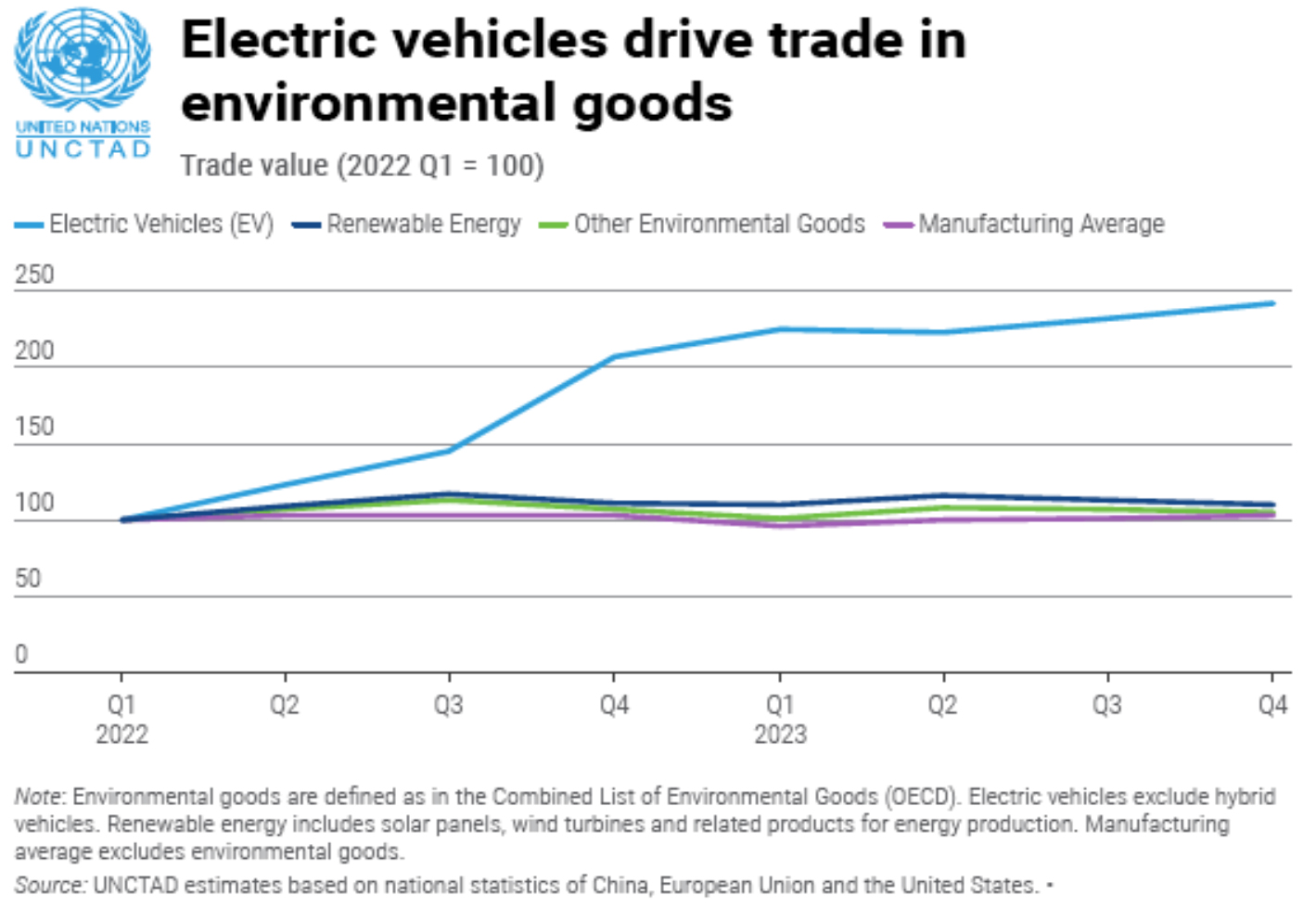
It is noteworthy that the Berne Union Climate Working Group (BU CWG) which is doing important work in supporting the climate goals of the wider export credit community, has come up with a “refreshed BU CWG workplan for 2024” in the wake of the developments at COP28. At the same time, Export Finance for Future (E3F), an international coalition, is working to align public export finance with climate change and goals.
Another major development is the allocation of up to USD50 billion to help build resilient infrastructure and inclusive societies in the African continent by the Arab Coordination Group (ACG) at the recent Arab-Africa and Saudi-Africa Summits’ Economic Conference in Riyadh. The ACG is a strategic alliance that provides a coordinated response to development finance. Current members are the Abu Dhabi Fund for Development, the Arab Bank for Economic Development in Africa, the Arab Fund for Economic and Social Development, the Arab Gulf Program for Development, the Arab Monetary Fund, the Islamic Development Bank, the Kuwait Fund for Arab Economic Development, the OPEC Fund for International Development, the Qatar Fund for Development, and the Saudi Fund for Development.
The ACG has been a long-standing supporter of African partner countries and has cumulatively invested over USD220 billion in the region to date. “We reaffirm our commitment to supporting the sustainable development of countries in Africa. Recognizing that the link between sustainable development and climate financing is cross-cutting and complex, the ACG reaffirms its commitment to scaling up financial assistance for climate change in line with the Paris Climate Agreement and to helping bridge investment gaps in energy access, including low-carbon energy sources, climate mitigation, adaptation, and resilience, as well as food security,” said the Group in a statement.
Proactive digitalization must be embraced as a core component of any new development agenda which multilateral institutions too must prioritize beyond their usual playbook. ICIEC has done so in its strategy which puts digitalization at par with its other development aims such as food security, energy transition, climate adaptation and mitigation, and poverty alleviation.
The post-COVID-19 acceleration in digitalization across economic and societal sectors presents not only a source of growth opportunities and new efficiencies, but also a spate of new risk for the insurance industry, especially the credit and investment insurance cohort. Trade, according to the WTO and industry organizations, has also become more digital, green, and inclusive. The digital revolution has bolstered trade in digitally delivered services by sharply reducing the costs of trading these services. The value of global trade in environmental goods and services has increased rapidly, outpacing total goods trade, and global value chains (GVCs) have expanded to encompass more economies.
The UN Global Sustainable Development Report (GSDR) 2023 similarly identifies digitalization as one of the six dynamic conditions shaping the achievement of the 17 Sustainable Development Goals (SDGs) by 2030 to which ICIEC is committed to helping its 49 member states progress towards achieving the goals in their development agenda through its financing, credit enhancement and risk mitigation solutions. The other five conditions include climate change, biodiversity and nature loss, demographic change, and inequality, all of which are also embedded in the policies and services offered by ICIEC.
Two further major developments in this respect are the launch in April 2024 by a coalition of ten MDBs, which includes the World Bank and IsDB, of a new co-financing platform – The Global Collaborative Co-Financing Platform (GCCP) that will enable them to channel additional capital for development scale and impact, and the IsDB and ICIEC’s accession to the Energy Transition Accelerator Financing Platform (ETAF) of the International Renewable Energy Agency (IRENA) in December 2023.
IRENA is creating a pipeline of energy transition projects and pairing them with investors to accelerate renewable energy deployment. The platform, established in 2021 with support from the United Arab Emirates, aims to scale up renewable energy projects that contribute to Nationally Determined Contributions (NDCs) in developing countries, while also bringing benefits to communities through enhanced energy access and security, and promoting economic growth and diversification.
According to Francesco La Camera, Director-General of IRENA, “today, the ETAF family is 13 partners strong, with collective pledges surpassing USD4 billion at COP28. The ETAF Platform also stands out for its inclusivity, offering a broad range of financial solutions and risk mitigation products. As members of ETAF, the Islamic Development Bank (IsDB) and the Islamic Corporation for the Insurance of Investment and Export Credit (ICIEC) have broadened the platform’s toolkit further with Islamic finance options, enhancing ETAF’s capacity to tailor its support to the unique requirements of numerous developing countries in the Islamic world.”
The Global Collaborative Co-Financing Platform will consist of the digital Co-Financing Portal which will create a secure platform for registered co-financiers to share project pipelines.
This tool, hosted at the World Bank, will increase efficiency and transparency, and make it easier for MDBs to share information and identify opportunities for co-financing. The Co-Financing Forum which will also provide a space for participants to discuss co-financing opportunities, best practices, and common issues, and will support ongoing efforts to coordinate policies to reduce the burden on partner countries.
According to the promoters, the GCCP will reduce the administrative burden and transaction costs and enable better coordinated financing in line with their priorities—resulting in greater development impact. By leveraging partnerships and promoting transparency, the platform will enable MDBs, partner agencies, and client countries to address global challenges including climate action more effectively and efficiently.
In the wider trade finance market, digitization is going from strength to strength, with most market players investing heavily in their trade and supply chain infrastructure. The real economy impact for ICIEC member states is implicit.
Growth of digitally delivered services exports, 2005-22
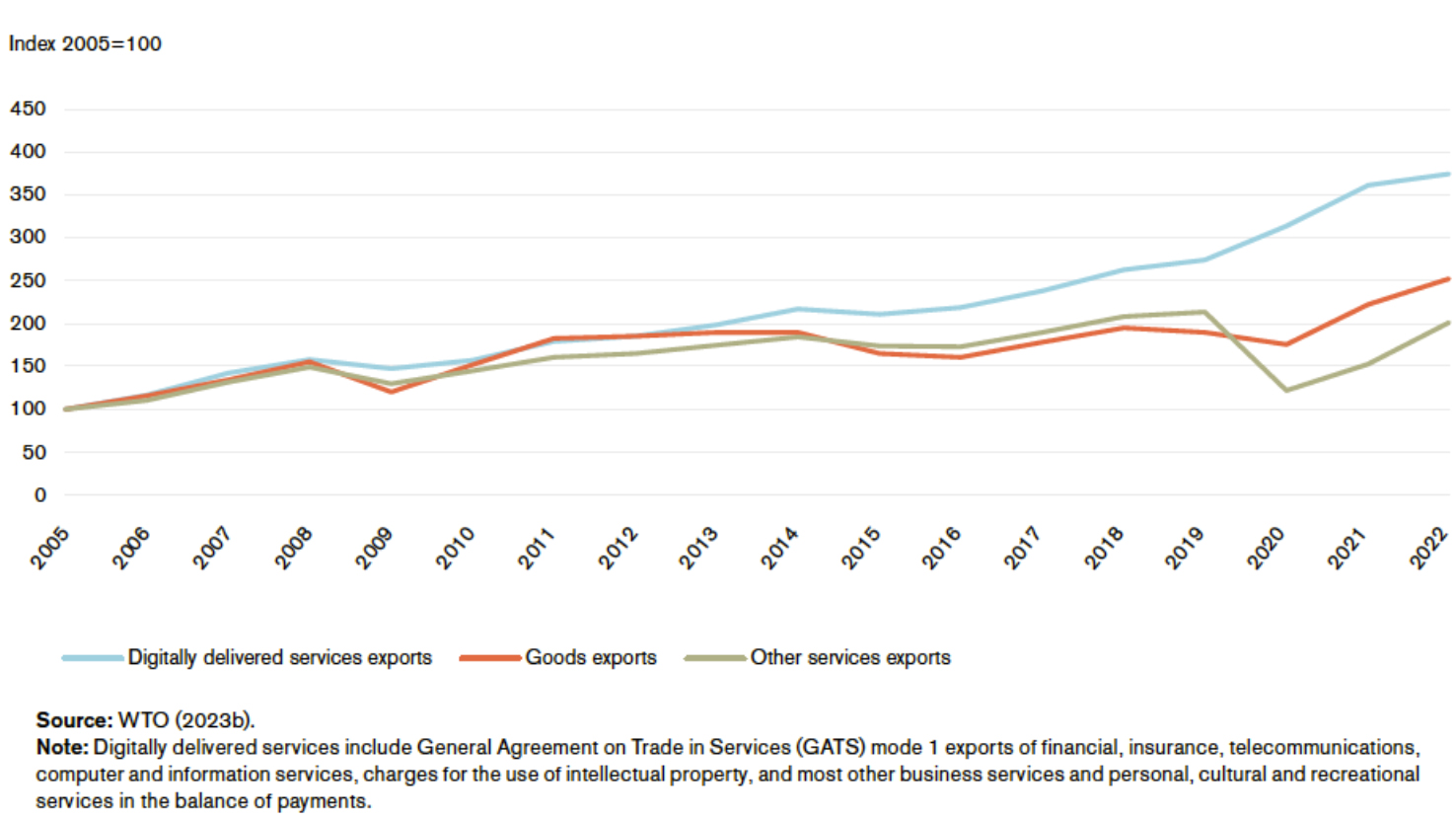
Digitisation has also been enabled by growth in platform-based trade, where FinTechs and challengers are innovating on new ways to capture market share and scale. Many banks are now participating in digital trade platforms, e.g., for e-invoicing, payables automation, supply chain financing and working capital management. These platforms vary by geographic reach, product and client focus, and underlying technology, but the market has been somewhat bifurcated.
“While digitisation supports the shift to open account through the development of new products, it also improves the efficiency and security of documentary trade, underpinning its continued importance in the product mix. Moreover, digitisation not only facilitates broad industry growth but also supports inclusive growth. It is seen as key to reducing the “trade finance gap” for SMEs, which has widened recently due to higher interest rates,” observed Boston Consulting Group (BCG) in a recent report.
The Power of Electronic Trade Documentation and Messaging
The UK’s Lloyds Bank in April 2024 completed its first transaction using an electronic Bill of Lading (eBL) on the WaveBL trade documentation platform, in a cross-border deal that featured entirely digital exchanges of documentation to support a British company in a trade deal with an Indian supplier.
The implications are game-changing. The operational impact of the deal revealed enormous cost and time-reduction implications, which the industry would not be able to ignore as the various platforms take off and mature. According to Lloyds Bank, eBL reduced transaction completion times from 15 days to just over 24 hours, which in turn reduced working capital costs and, together with the use of a digital promissory note (dPN), made the trade deal entirely paper-free. The WaveBL network boasts members in 136 countries and includes four of the world’s ten largest container shipping carriers.
The three other major developments in the electronic trade documentation architecture are:
- The Electronic Trade Documents Act (ETDA) 2023 in the UK receiving Royal Assent from King Charles III last July, legally effective on 20 September 2023, to make Global Britain’s trade with partners all over the world seamless, efficient, and sustainable.
- The enhancement of the Model Law on Electronic Transferable Records (MLETR).
- The WTO’s initiative in including work on trade-related aspects of e-commerce as part of the organization’s Joint Statement Initiative (JSI) on E-commerce in future WTO negotiations.
There is no doubt that a major boost can come from the UK’s ETDA with the British Government’s initial estimate that the UK economy is set to receive a GBP1.14 billion boost over the next decade. With less chance of sensitive paper documents being lost, and stronger safeguards using technology, digitalizing trade documents are set to give businesses that trade internationally greater security.
With English law being the very foundation of international trade, including several Islamic finance contracts such as the Commodity and Syndicated Murabaha and Sukuk issuance, it has important implications for the global Islamic finance industry. The UK is widely seen as a leader in digital trade and this new act will make it easier for businesses to trade efficiently with each other, cutting costs and growing the UK economy by billions over time.
According to the WTO, the UK’s EDTA removes requirements for the majority of paper trade documentation. Varying degrees of progress are also being made towards implementation in the remaining G7 countries, with each taking unique approaches to amend and introduce legislation.
Another important development is the successful testing of an interoperability solution capable of enabling the widespread use of electronic documents that are critical to digitise trade by Swift, in collaboration with BNY Mellon, Deutsche Bank and four electronic Bills of Lading (eBL) platforms.
According to Shirish Wadivkar Global Head, Wholesale Payments and Trade Strategy at Swift, “standards set with the industry – combined with global interoperability facilitated by Swift – can enable eBL providers and digital trade platforms to seamlessly interact with banks, corporates, and the wider trade ecosystem. Such industry-wide collaboration is essential to achieve a ‘zero paper trade’ future.”
The Lack of Technical of Interoperability Between Platforms
According to Swift, there is much to gain by digitising global trade, from reducing costs and improving transparency to mitigating fraud and addressing the USD2.5 trillion trade finance gap. Paper-based Bills of Lading – associated with lengthy delays and inefficient processes – offer a significant opportunity for improvement.
Compared to their paper equivalent, eBLs reduce the risk of document loss and fraud, speed up the transfer of documents and shrink the carbon footprint associated with paper processes. McKinsey predicts that adopting eBL could save the industry USD6.5 billion a year and enable USD40 billion in global trade by 2030. However, while the need for eBL adoption is generally recognised, the data according to the FTI Alliance, shows that in 2022, only 2.1% of bills and lading and waybills in the container trade were electronic.
The good news is that some 80 institutions have signed up to FIT Alliance’s ‘Declaration of the Electronic Bill of Lading’ which commits international trade stakeholders to drive digitalisation within their industries, starting with eBL. With a significant proportion of global trade conducted using English law documents, an important milestone was the passing of the UK ETDA, which grants electronic trade documents the same legal significance as the paper equivalent and gives eBL created under different systems legal equivalency for the first time.
The current lack of technical interoperability between existing eBL platforms, says Swift, presents a significant obstacle to wholesale adoption. The nine eBL providers authorised by the International Group of Protection and Indemnity Clubs (IGP&I), for instance, each have their own rules and customer bases, meaning that customers of one eBL system can’t take part in transactions handled by another eBL system. Instead, financial institutions, corporates, and others involved in each trade transaction, need to connect to multiple systems – an approach which is both inefficient and costly. Such ‘digital islands’ are not sustainable.
“Interoperability is needed between different eBL platforms so that users can interact with each other using a single identity. Given our long history of enabling global interoperability – and recent initiatives such as our solution to interlink central bank digital currencies (CBDCs) – we believe Swift can play an important part in addressing the eBL challenge,” maintains Swift’s Shirish Wadivkar.
Swift in fact started working with FIT Alliance partners and eBL platform providers in 2022 to develop an API-based eBL interoperability model. Under this approach, firms could leverage a single connection to Swift to interact with trade transactions carried out using multiple different eBL platforms. In 2023 the partners ran a Proof of Concept (PoC) to test how an interoperability solution could work in practice, collaborating with eBL platforms edoxOnline and CargoX in the first phase to test the use of a single ubiquitous API contract to open a secure channel with Swift, and expanding the PoC to include two additional eBL platform providers – TradeGo and WaveBL – as well as BNY Mellon and Deutsche Bank. Using the same API layer, participants were able to successfully reproduce the end-to-end flow transfer process of an eBL in a simulated trade transaction.
The Beguiling Lure of Generative AI in Trade
Perhaps the biggest potential change in the near-to-medium term may come in digital underwriting and digitalization in commercial insurance lines using targeted Generative AI, according to Swiss Re. But for trade cohorts, it is important in the current climate of AI hype not to over-think nor over-talk the significance of AI to facilitate an orderly transformation to this very disruptive and yet inevitable technology.
“Along with the use of big data,” says Swiss Re, “AI is expected to be eventually used widely in risk assessment and underwriting. Given the level of confidence needed to deploy new technologies in underwriting, fully digitalized/automated AI, and Machine Learning (ML) enabled systems are still not accurate enough for use at scale. This also means that algorithms cannot be relied on to fully replace traditional risk assessment, except in simpler lines of business such as motor. This said, digitalization can complement existing processes, including classifying and segmenting risk as finely as possible for more accurate risk pricing.”
Increasingly, commercial insurers are making use of digital technology in portfolio steering and risk selection. The benefits are important. “By leveraging third-party digital data overlaid with their own information,” stresses Swiss Re, “they can derive insights on potential risk accumulation, such as that caused by a concentration of high-value properties exposed to specific hazards. For example, the utility sectors’ liability exposure is increasing due to infrastructure that can spark fires. Utilities may operate in wildfire prone regions (such as network operators, tree cutters). Using third-party digital data on, for instance, locating sources of ignition such as power lines and rail tracks, insurers have a deeper view as to areas of potential fire risk accumulation.”
The WTO Informal Working Group on Micro-and-Small-and Medium-sized-Enterprises (MSMEs) initiative involves 89 (as of July 2023) member states, accounting for over 90% of global trade. These negotiations span a broad range of critical topics such as online consumer protection, electronic signatures and authentication, electronic contracts, transparency, paperless trading, open internet access, and data flows and data localization. The Group continues to discuss challenges for MSME access to digital trade, including cyber readiness, standardizing trade digitalization, and single windows (or access points) to access trade information.
In this respect, the recent launch by the World Bank Group’s private sector funding arm, the International Finance Corporation (IFC), of the USD4 billion MSME Finance Platform to aid financial service providers in delivering funds to small businesses in emerging markets through banks, non-bank financial institutions, microfinance institutions, and innovative digital lenders, with a particular focus on those owned by women and those in the agriculture and climate sectors, assumes much greater importance. The Platform, according to Makhtar Diop, Managing Director of IFC, will also use various forms of credit enhancement to mobilise private capital, including an innovative Catalytic First Loss Guarantee, aiming to attract an additional USD4 billion in financing from eligible financial service providers to expand lending to these businesses.
Digitalization of trade could be a great equalizer and facilitator by providing new opportunities for those economies that have so far been left behind by allowing them to overcome some of the most important barriers to trade that they face, such as transportation costs and institutional disadvantages.
Transitioning to ISO 20022
The introduction of ISO 20022 by the International Organization for Standardization (ISO), as “a single standardisation approach (methodology, process, repository) to be used by all financial standards initiatives,” is a key development and challenge for the trade finance and credit insurance industry.
ISO 20022 (MX), which comes into effect in November 2025, is the next generation of financial messaging standards given its key characteristics of a common language with rich and structured data. The Swift MT format has been the standard for trade finance messages for the last four decades.
According to Trade Finance Global, (TFG), Swift (the world’s leading provider of secure financial messaging services) is “already in the process of migrating payment and cash management messages from the legacy MT format to MX. In November 2025, when the current MT and MX coexistence period is set to end, all Swift traffic for cross-border payments and reporting (CBPR+) will be on an ISO 20022 standard.
As the payments and cash management industry is finding out in real time, there are benefits, challenges and costs associated with such a wholesale transition. It is however something which banks, insurers and other stakeholders in the trade finance and insurance community would ignore or delay preparedness at their peril.
Some Positive Developments
The WTO and the International Credit Insurance and Surety Association (ICISA), which brings together the world’s leading companies that provide credit insurance and/or surety bonds, have trade and gender working groups. The problem is that these are Informal Working Groups (IWGs) set up by involved and activist women as opposed to permanent structures within the articles of association of the entities.
They have their work cut out given that it was only the 13th WTO Ministerial Conference (MC13) Declaration which recognized the importance of promoting women’s participation in trade. Another problem is that often women’s participation in trade is merely side lined as a Financial Inclusion initiative for female entrepreneurs, traders, and Micro, Small and Medium-sized Enterprises (MSMEs) as important as it is to help policymakers design gender-responsive trade policies, as opposed to a mainstream activity across the trade ecosystem.
The WTO’s IWG is also spearheading proposals on developing gender-disaggregated data and statistics relating to women in world trade.
Similarly, ICISA’s Women in Credit Insurance (WICI), founded in 2023, is an informal association of individuals, which strives to increase the representation of women in the trade credit insurance industry especially in leadership roles, through mentorship, speed networking and training. Members include high-flying women experts from Allianz Trade, Aon, Atradius, Coface, FinCred, Marsh and TokioMarine HCC.
The Gambia, a member state of ICIEC, has recently showcased several initiatives under its National Development Plan (2023–2027), including the SheTrades programme and the Jokallenteh Market platform, which connects women farmers to markets. These programmes aim to economically empower women and to achieve significant milestones in training, market linkages, access to finance and public procurement. Notable successes include supporting over 130 women-owned businesses in food safety and quality and securing USD3 million in public tenders for women bidders, specifically for food aid supply.
Diversity and gender balance is an important consideration for ICIEC, which has 49 member states as shareholders. The Corporation has a total number of 85 employees, of which 14 are female employees, which rightly suggests that there is much room for improvement. Currently Fatma Gamze Sarioglu, serves as the Senior Country Manager for Türkiye at ICIEC, Khady Seye as Country Manager for Senegal, Sabah Al Harbi as Country Manager for the MENA Region, and Eman A. Mahmoud, Country Manager, IsDB and ICIEC’s Cairo Regional Hub.
The consensus remains that there are significant gender disparities in export activities which underscore the imperative of providing enhanced support for women in the realm of international trade. Securing gender equality in domestic legislation is consistent with providing equal conditions for men and women to access economic opportunities brought by international trade whether in business, finance, credit insurance and surety and policy making.
In this context the WTO-sponsored World Trade Congress on Gender on 24-27 June 2025, under the theme “Gender Equality and Innovation: The Keys to Sustainable Trade,” assumed a much greater urgency and importance.
Charting a Post-COP28 Climate Action Path - ICIEC’s Green Leap Forward

Given that Baku is the host city for COP29 at the end of 2024, the focus for the third consecutive Conference of the Parties (COP) under the aegis of The UN Framework Convention on Climate Change (UNFCCC) converges on Azerbaijan, the newest ICIEC accession Member Country, following in the footsteps of Sharm El Sheikh for COP27 and Dubai for COP28. In the UAE, ICIEC also launched its much-anticipated Climate Change Policy and ESG Framework. Salih Suwarelzahab, Senior Legal Counsel and Climate Action Team Lead at ICIEC, looks ahead to a post-COP28 Climate Action, Finance and Risk Management Pathway underpinned by the Corporation’s transformative results-oriented Climate Change Policy and ESG Framework, the IsDB Group synergies, the role and importance of partnerships with global best practice institutions and the private sector, and the promise and opportunities of Azerbaijan’s brave new Green Energy and Decarbonisation Strategy.
COP28 in the United Arab Emirates (UAE) represents a watershed moment in ICIEC’s history with the launch of ICIEC’s Climate Change Policy and ESG Framework. The publishing of the two key documents reflects an ongoing commitment towards mainstreaming Climate Action that began in 2021 at COP26 in Glasgow, in which Mr. Oussama Kaissi, CEO of ICIEC, participated.
Through a stepwise approach ICIEC setup a Taskforce dedicated to Climate Action and implemented the screening of Political Risk Insurance projects for Climate Risks. ICIEC staff were trained in Climate Change Fundamentals, whilst existing partnerships were steered towards addressing common objectives around sustainability and climate change, and new partnerships were forged, such as ICIEC’s membership of the InsuResilience Global Partnership for Climate and Disaster Risk Finance and Insurance Solutions in 2022.
In 2023 a total business insured target of 10% was dedicated to Climate Action and this target was reached and surpassed. In 2024 the target for total business insured for Climate Change projects and transactions was increased to 13%.
Climate Change Policy
ICIEC Climate Change Policy serves as a testament to our dedication to addressing climate change head-on. It is our blueprint for a greener, cleaner, and more sustainable world. Through this policy, we outline our commitment to reducing carbon emissions, protecting our planet’s invaluable natural resources, and promoting sustainable economic growth.
The ICIEC Climate Change Policy establishes to:
- Support Member States to meet their commitments under the Paris Agreement, particularly their Nationally Determined Contributions (NDCs).
- Promote investment and trade opportunities that support resilience, playing a pivotal role in reducing greenhouse gas emissions and enhancing adaptability to climate change.
- Be aligned with The Islamic Development Bank Group by guaranteeing projects and investments that are in line with the Group’s climate action objectives.
- Engage with Financial Institutions to promote business models and investments that are focused on renewable, energy-efficient, natural capital, among other environmental themes, aligning with the broader transition towards the low-carbon economy.
| ICIEC Climate Change Policy | |
|---|---|
| Internal Operations | Operationalization of climate change management across ICIEC internal operations focusing on decarbonization initiatives, policies, and plans to manage the organization’s own carbon footprint. |
| Insurance and Resinsurance | Opportunities for ICIEC to incentivize and contribute to scaling up climate agenda across member countries. |
| Risk Management | Approach to climate-related risks in Risk Management |
| Contribution to Capacity Building | Integration of climate change in ICIEC capacity building support and engagement with member countries. |
| Communication | Development of climate change-specific reporting at the level of the organization and its development impact intervention in member countries. |
ICIEC’s Climate Change Policy and ESG Framework mark the commencement of a transformative results-oriented process where ICIEC’s operations, insurance, de-risking, physical assets and human capital and focus are addressing the Climate Crisis at their core, based on the needs of ICIEC’s member countries, IsDB Group synergies, the role of the private sector in climate finance and industry best practice. 2024 sees the second phase of the Climate Change project which is dedicated to screening, monitoring and evaluation based on practical, achievable and industry benchmarked parameters that take all ICIEC’s business lines into account.
At the institutional level, the year 2024 will witness the responsibility for Climate Change and ESG being housed in a dedicated Function whilst capacity building continues to be offered to all operations staff who will have specific climate change specific KPI’s. Staff who are trained in climate change are naturally better equipped to proactively seek out transactions and projects that contribute towards climate change mitigation, adaptation and/or resilience. A stock take of ecological consumption versus potential savings will take place on ICIEC’s physical premises with clear environmentally friendly recommendations made and implemented, and travel mission carbon footprints will be mitigated through investment in certifiable carbon sink schemes in ICIEC member countries.
Collaboration & Smart Partnerships the Key
Collaboration and smart partnerships remain at the heart of ICIEC’s Climate Action strategy as the global climate funding gap continues to grow whilst climate disasters proliferate. Through smart partnerships, ICIEC has signed a number of MoUs with technology and industry leaders such as GE Vernova, multilateral institutions focused on designing climate-based solutions such as the Global Green Growth Institute and export credit agencies (ECA’s) whose portfolio of transactions and supported companies are predominantly renewable energy based, such as EKF of Denmark.
Closer to ICIEC Headquarters, outreach is underway with the Saudi and Middle East Green Initiatives in order to tap into the value chains of carbon sequestration and the circular economy. A methodological approach to partnerships has ICIEC member states’ National Determined Contributions and National Adaptation Plans at its core.
Due to its proximity to its member countries, ICIEC, through the Member Country Partnership Strategy of the IsDB Group, remains cognizant of the priority areas of respective member countries for climate action. This know-how is invaluable to financial institutions that have financing targets and that need ICIEC’s de-risking and insurance support to access new markets and to expand their footprint in existing ones. Furthermore, specialized companies in member countries that produce goods or services that contribute towards climate action are continuously identified with a view to assisting their activities in other ICIEC member states and beyond.
ICIEC joined ETAF, the Energy Transitional Accelerator Financing Platform, managed by IRENA, at COP28 in Dubai in recognition of the need to bring diverse, effective partners (including the private sector, multilateral lenders and renewable energy industry leaders) around the same table in order to support the rollout of renewable energy projects to the amount of US$4 billion by 2025. ICIEC, as a member of the International Union of Credit and Investment Insurers (the Berne Union), which celebrates its 90th anniversary this year, has been invited to join the Berne Union Climate Working Group and shall bring the perspective of the Economic South and 49 member countries in the search for export credit and insurance-based contributions and solutions to the climate crisis.
As a founding member of the AMAN Union of Commercial and Non-commercial Risk Insurers and Reinsurers in member countries of the Organisation of Islamic Cooperation (OIC) and the Arab League, ICIEC strives to provide climate leadership and assistance to sister ECA’s in member countries as the common challenges posed by the climate crisis invariably provide opportunities for growth in new economic sectors.
Azerbaijan’s Competitive Green Advantages
Since COP26, two COPs have fortuitously been hosted by ICIEC member countries, COP27 in Sharm El Sheikh, Egypt, whose focus was on adaptation, and COP28 in Dubai, in the UAE with COP29 being hosted by ICIEC’s newest member country Azerbaijan. Azerbaijan is one of the oldest and most pioneering oil producing countries in the world, with drilling and extraction activities dating back to at least the 1800’s.
Few countries reflect energy transition in a similar manner to Azerbaijan with a commitment to produce 30% of energy from renewables by 2030 and with the potential to be a green hydrogen hub and key supplier to the European Union, capitalizing on 23,000 MW of solar power potential, 800 MW of wind energy power, 520 MW of hydropower energy and 800 MW of geothermal energy. In a geopolitical energy ecosystem rife with uncertainty and volatility due to the conflict in Ukraine, if implemented correctly, Azerbaijan’s hydrogen potential is capable of providing the ultimate win-win scenario and playbook, clean fuel for the European Union (EU) market in line with EU pledges, legislation and taxonomies, and a new and profitable global export for Azerbaijan.
One of Azerbaijan’s competitive advantages for green hydrogen export is the existing pipeline infrastructure that was designed and built to export hydrocarbons. Across ICIEC’s 49 member countries whilst the severity of the climate crisis continues to become more manifest, innumerable opportunities for green growth emerge that are spurred on by innovation, technology and enterprise.
ESG Framework
The ICIEC ESG framework is a comprehensive strategy that reflects the organization’s strong commitment to environmental, Social, and Governance (ESG) principles. It is designed to integrate ESG values into every aspect of ICIEC’s operations and decision-making. Key elements of the ICIEC ESG framework include:
- The framework underscores the importance of embedding ESG principles at the core of ICIEC’s operations.
- ICIEC’s governance structure ensures oversight of ESG initiatives and their integration into the overall business strategy.
- ICIEC focuses on developing ESG-centric products and services while incorporating ESG criteria into risk assessment and underwriting.
- ICIEC implements various measures to promote sustainability throughout its internal processes, from HR to supply chain management and policies.
- ICIEC actively aligns with global sustainability objectives and collaborates on initiatives that contribute to these goals.
- ICIEC’s framework includes a robust ESG reporting mechanism that promotes transparency and accountability, ensuring stakeholders are informed about ICIEC’s ESG performance
Collaboration & Smart Partnerships the Key
Collaboration and smart partnerships remain at the heart of ICIEC’s Climate Action strategy as the global climate funding gap continues to grow whilst climate disasters proliferate. Through smart partnerships, ICIEC has signed a number of MoUs with technology and industry leaders such as GE Vernova, multilateral institutions focused on designing climate-based solutions such as the Global Green Growth Institute and export credit agencies (ECA’s) whose portfolio of transactions and supported companies are predominantly renewable energy based, such as EKF of Denmark.
Closer to ICIEC Headquarters, outreach is underway with the Saudi and Middle East Green Initiatives in order to tap into the value chains of carbon sequestration and the circular economy. A methodological approach to partnerships has ICIEC member states’ National Determined Contributions and National Adaptation Plans at its core.
Due to its proximity to its member countries, ICIEC, through the Member Country Partnership Strategy of the IsDB Group, remains cognizant of the priority areas of respective member countries for climate action. This know-how is invaluable to financial institutions that have financing targets and that need ICIEC’s de-risking and insurance support to access new markets and to expand their footprint in existing ones. Furthermore, specialized companies in member countries that produce goods or services that contribute towards climate action are continuously identified with a view to assisting their activities in other ICIEC member states and beyond.
ICIEC joined ETAF, the Energy Transitional Accelerator Financing Platform, managed by IRENA, at COP28 in Dubai in recognition of the need to bring diverse, effective partners (including the private sector, multilateral lenders and renewable energy industry leaders) around the same table in order to support the rollout of renewable energy projects to the amount
of US$4 billion by 2025. ICIEC, as a member of the International Union of Credit and Investment Insurers (the Berne Union), which celebrates its 90th anniversary this year, has been invited to join the Berne Union Climate Working Group and shall bring the perspective of the Economic South and 49 member countries in the search for export credit and insurance-based contributions and solutions to the climate crisis.
As a founding member of the AMAN Union of Commercial and Non-commercial Risk Insurers and Reinsurers in member countries of the Organisation of Islamic Cooperation (OIC) and the Arab League, ICIEC strives to provide climate leadership and assistance to sister ECA’s in member countries as the common challenges posed by the climate crisis invariably provide opportunities for growth in new economic sectors.
ICIEC and Climate Action
Partnership: ICIEC is proud to announce the signing of several key partnerships to provide a framework for joint action in promoting climate action, green projects, extending training and capacity-building opportunities, and organizing joint seminars and workshops. These collaborations will enable us to better understand our shared challenges related to climate change mitigation efforts as well as help create a more sustainable future for all. We are confident that these initiatives will bring positive changes both locally and globally by providing access to resources that can help reduce emissions while also creating jobs through green investments.
- ICIEC has been proactively aiding the OIC member states in reaching their climate objectives. An innovative step by ICIEC in this direction is the Green Sukuk Insurance Policy, facilitating Sukuk issuers to secure capital for viable green initiatives. Furthermore, ICIEC is providing de-risking solutions for regional funds in Africa, focusing on mitigation and adaptation measures.
- Towards a sustainable financial horizon, ICIEC has put forth the idea of a climate-centric fund in collaboration with institutional partners. This proposed fund is poised to offer discounted insurance premiums for financing Climate Action initiatives, especially in the Least Developed Member States. Additionally, ICIEC is committed to capacity building, leading to the provision of climate change training for its employees.
- To underscore its commitment to the Climate Action cause, ICIEC has become a part of the InsuResilience Global Partnership, aiming for climate disaster risk finance and solutions. This move solidifies ICIEC’s position as a pioneer among its industry contemporaries. Presently, ICIEC signed a Collaborative Partnership Agreement with The International Renewable Energy Agency (IRENA), through the Energy Transition Accelerator Financing Platform (ETAF), a multi-stakeholder climate finance solution.
- ICIEC has signed an agreement with ”Aware for Projects”, a landmark online climate risk screening software solution. This new tool will help the Corporation identify potential climate change risks and develop a consistent approach to assessing them.
- ICIEC developed a Climate Change Policy and ESG Guidelines to institutionalize its Climate Action and Green Finance commitments.
Azerbaijan’s Competitive Green Advantages
Since COP26, two COPs have fortuitously been hosted by ICIEC member countries, COP27 in Sharm El Sheikh, Egypt, whose focus was on adaptation, and COP28 in Dubai, in the UAE with COP29 being hosted by ICIEC’s newest member country Azerbaijan. Azerbaijan is one of the oldest and most pioneering oil producing countries in the world, with drilling and extraction activities dating back to at least the 1800’s.
Few countries reflect energy transition in a similar manner to Azerbaijan with a commitment to produce 30% of energy from renewables by 2030 and with the potential to be a green hydrogen hub and key supplier to the European Union, capitalizing on 23,000 MW of solar power potential, 800 MW of wind energy power, 520 MW of hydropower energy and 800 MW of geothermal energy. In a geopolitical energy ecosystem rife with uncertainty and volatility due to the conflict in Ukraine, if implemented correctly, Azerbaijan’s hydrogen potential is capable of providing the ultimate win-win scenario and playbook, clean fuel for the European Union (EU) market in line with EU pledges, legislation and taxonomies, and a new and profitable global export for Azerbaijan.
One of Azerbaijan’s competitive advantages for green hydrogen export is the existing pipeline infrastructure that was designed and built to export hydrocarbons. Across ICIEC’s 49 member countries whilst the severity of the climate crisis continues to become more manifest, innumerable opportunities for green growth emerge that are spurred on by innovation, technology and enterprise.
Navigating a Future Without Oil and Gas

Azerbaijan’s Brave New Green Energy Strategy with a Stated Role for Islamic Finance, Investment and De-risking Solutions
Given that Baku is the host city for COP29 at the end of 2024 and Azerbaijan is a recent ICIEC accession member state, it is no surprise that the Government of President Ilham Aliyev is prioritising key economic development areas such as the promotion of regional connectivity (rail, gas pipelines, and electricity transmission), decarbonization especially through solar and wind renewable energy, the ‘Middle Corridor’ project which is aimed at supporting SMEs through collaboration with local domestic banks, and the promotion of Islamic finance and ICIEC’s credit and investment de-risking insurance. Oguz Aktuna, Acting Manager, Asia Region Division, Business Development Department at ICIEC, profiles Azerbaijan’s clean energy transition status and its Net Zero pathway, and ICIEC’s recent and future involvement in the country’s SDG and decarbonisation journey.
Azerbaijan joined membership of ICIEC in January 2023. Azerbaijan will host the COP29 Climate Summit in Baku in 2024. This signifies a crucial global event, with the country hosting the climate conference for the first time in the Central Asian region. ICIEC on the other hand, with its experience in renewable projects will support Azerbaijan’s clean energy transition and its Net Zero pathway.
Azerbaijan plays a crucial role as an energy hub and as a transportation corridor in the region by connecting the CIS (Commonwealth of Independent Central Asian States) to Europe. In 2023, ICIEC, together with the Government of Azerbaijan, outlined key priorities to participate in projects for the economic development of the country, such as the promotion of regional connectivity (rail, gas pipelines, and electricity transmission), decarbonization (renewable energy – Solar, Wind), the “Middle Corridor” project, supporting SMEs through collaboration with local domestic banks, promotion of Islamic finance and Islamic insurance and supporting the reconstruction of the Karabakh enclave.
Azerbaijan’s economic progress has historically relied on oil and gas exploration, constituting 95% of its export revenue. Despite this, the country has embraced global efforts to combat climate change, ratifying the Paris Climate Agreement in 2017. Azerbaijan announced a goal of reducing greenhouse gas emissions by up to 35% by 2030 and 40% by 2050 compared to 1990 levels.
The International Energy Agency (IEA) predicts a 25-year lifespan for Azerbaijan’s oil reserves, emphasizing the need for alternative energy sources. It should be mentioned that the climatic conditions in Azerbaijan present significant opportunities for generating electricity through solar and wind resources. Key renewable energy sources include onshore and offshore wind farms/clusters, solar power, and hydroelectricity. The potential for solar and wind power generation is particularly noteworthy.
Azerbaijan is currently entering a strategic development phase. The focus is on creating economic opportunities in newly liberated territories (Karabakh, Eastern Zangazur and Nakhchivan), emphasizing a modern construction model and a “Green Energy Zone” with stated net-zero emissions. The government has undertaken extensive infrastructure development, including power transmission lines, substations, and hydroelectric projects. The Central Bank of Azerbaijan is developing a strategy to incorporate sustainable finance principles into the financial sector, including banking, insurance, and capital markets. Commitment to clean technologies, the use of clean energy, recycling, and environmental remediation is a key aspect of Azerbaijan’s policy.
Azerbaijan’s Green Energy Focus
To adhere to the targets Azerbaijan has initiated partnerships in “green energy” projects involving key players such as Masdar (Abu Dhabi Future Energy Company), ACWA Power, BP, and others. Such plans include the construction of the solar and wind energy projects with Masdar, for a total capacity of up to 1.0 GW onshore and offshore. ACWA Power has entered into implementation agreements with the Azerbaijani Ministry of Energy for the development of a 1.0 GW onshore wind farm and a 1.5 GW offshore wind farm featuring energy storage. In October 2023, the Garadagh Solar Power Plant (230 MW) constructed in cooperation with Masdar, came on stream.
The country aims to strengthen its electricity network to integrate 1,862 MW of “green power” by 2027. Efforts are underway to establish the “Caspian-EU Green Energy Corridor” and the “Azerbaijan-Turkey-Europe Corridor”, with plans to export approximately 5 GW of green electricity through various routes by 2030. To achieve this objective, leaders of the governments of Azerbaijan, Georgia, Hungary, and Romania have collectively signed a Memorandum of Understanding (MoU) for the construction of the Black Sea Energy Subsea Cable. Furthermore, Azerbaijan expresses a keen interest in involving other Caspian littoral countries, such as Kazakhstan and Turkmenistan, in this project.
In 2019, the IsDB’s Board of Executive Directors (BED) approved the IsDB Climate Change Policy. During COP28, ICIEC announced the launch of its groundbreaking Climate Change Policy and ESG Framework and an agreement to join the Energy Transition Accelerator Financing (ETAF) Platform, managed by the International Renewable Energy Agency (IRENA). ICIEC recognizes that export credit insurance and political risk insurance are essential tools to bridge the Climate Action finance gap by de-risking investments and access to capital goods and green technology, thus making them more attractive and bankable to private sector participation.
Spanning the Water-Energy-Food Value Chain
Climate Action encompasses the range of vital value chains that span the Water- Energy-Food as relates to climate change resilience, mitigation and adaptation, which is reflected in the range of projects and interventions that ICIEC continues to support in its Member States. ICIEC’s innovative solutions provide protection against nonpayment risks associated with international trade transactions, while also providing support for green investments in renewable energy projects, low-carbon transport systems, clean technology transfers and other sustainable initiatives.
ICIEC is committed to helping our 49 Member States achieve their development goals, including resilience, mitigation and adaptation to the threats posed by climate change. ICIEC cover has been directed towards various sectors over the years, with US$2.35 billion going specifically into clean energy initiatives such as solar energy systems and wind farms – assisting with their importation and use in national infrastructure projects. With this commitment to ICIEC Member States’ development goals, we strive to help mitigate threats from climate change so that all stakeholders may benefit from a better future together.
Historically, ICIEC, as a multilateral credit and political risk insurer, has been playing an important role in facilitating renewable energy projects in its Member Countries. For example, in 2016, ICIEC supported 316 MW Wind Farm Projects in Turkey and provided a US$80 million reinsurance cover to Eksport Kredit Fonden (EKF), – the Danish ECA, now rebranded as EIFO. In 2018, ICIEC provided US$68 million in political risk cover to support Alcazar Energy’s (UAE) investment in four 50MW solar plants. The project is part of Egypt’s Nubian Suns Renewable Energy Feed-in Tariff (FiT) programme announced in September 2014, which is in line with the Egyptian government’s Sustainable Energy Strategy 2035.
In Sharjah, UAE, ICIEC supported the waste-to-energy (WtE) project, led by Masdar, and Bee’ah (Sharjah Environment Company). ICIEC provided insurance cover for the project’s construction financing, working in partnership with SMBC, the leading Japanese bank. During COP 28 ICIEC and Standard Chartered Bank signed a Non-Honoring of Sovereign Financial Obligation (NHSFO) policy for supporting the project of procuring and installing 50,000 off-grid solar-powered streetlamps across Senegal’s rural areas.
We will continue our support for clean energy projects in our Member Countries. In 2023, ICIEC and Masdar signed an MoU to promote renewable energy projects in Member Countries using ICIEC’s credit enhancement and risk mitigation solutions. During COP 28, ICIEC and GE Energy Financial Services, Inc. (GE Vernova) inked an MoU aimed at bolstering sustainable development and climate action across ICIEC’s 49 Member Countries.
Francesco La Camera, Director-General International Renewable Energy Agency (IRENA)
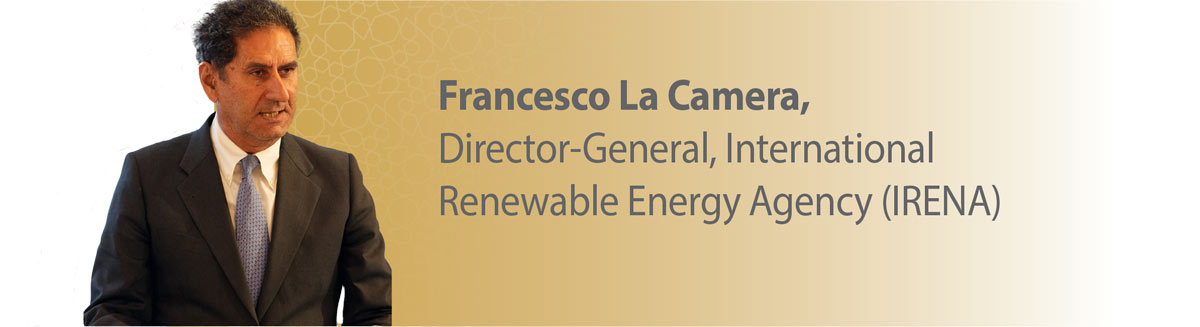
Transforming the Progress of the ‘UAE Consensus’ at COP28 on Tripling Renewables through Greater Alignment of NDCs with National Energy Plans
One of the positive outcomes of COP28 in Dubai was the setting of a global target to triple renewable energy capacity by 2030. The so-called ‘UAE Consensus’ seems to have cemented the role of renewables as one of the most effective ways to address climate change and transition to a just and clean energy dispensation. As the ‘Custodian’ of the global renewable energy pledge, the International Renewable Energy Agency (IRENA) is committed to monitoring the progress towards achieving the targets on an annual basis and track COP28 commitments to maintain momentum to 2030. Francesco La Camera, Director-General of IRENA, here discusses the challenges and opportunities for renewables at a time when current global and national commitments fall short of the necessary levels required by between 30-50% by modernising existing physical infrastructure to support and accelerate the renewables grid system and regulatory architecture to facilitate investments and improve socio-economic and environmental outcomes, the urgent need to develop a ‘fit-for-purpose’ workforce, and the role of Islamic finance options especially innovative de-risking and credit enhancement involving also private capital in enhancing IRENA’s Energy Transition Accelerator Financing (ETAF) Platform and toolkit, to which the IsDB and ICIEC signed up to in Dubai.
ICIEC Quarterly Newsletter: Now that the fog of COP28 Dubai has settled, can you share your assessment of COP28 per se, and those relating in particular to achieving the Paris Net Zero targets by 2050, the holy grail of restricting global warming to 1.5ºC and the state of renewable energy in the global energy mix? What are the investment needs according to IRENA? How do they compare to where we are now?
By setting a global target to triple renewable energy capacity by 2030 to more than 11 TW, the UAE Consensus at COP28 in Dubai has successfully cemented the role of renewables as one of the most effective energy solutions to address climate change, creating unprecedented momentum and crystal-clear direction for the energy transition.
We are proud that IRENA’s World Energy Transitions Outlook served as the foundation for this target. The chance to achieve the goals of the Paris Agreement is slipping away, we cannot afford to miss the closing window of opportunity. Now it is on governments to match this increased ambition with concrete plan and action.
IRENA’s World Energy Transitions Outlook 2023 makes sober reading but also highlights the huge benefits a just energy transition could bring in terms of GDP growth, jobs, poverty alleviation, and remedies from the devastating impacts of climate change. Do you think the pledge made by Heads of State at COP28 to triple global renewable energy capacity by 2030 is achievable when funding commitments made on climate action at previous COPs were not met? Do you agree that accelerating transition progress worldwide requires a shift away from mindset and structures built for the fossil fuel era? In this respect what is your view on the UAE COP28 Presidency’s call for a Global Renewable Energy Target to complement that of the Paris one? Fossil fuel producers argue for an orderly transition period given the role they have in forex earnings, revenues, job creation, financing budgets and development agendas. Do you agree?
Doubling down on the energy transition should not be viewed as a cost, rather as an investment opportunity. Our analysis clearly shows that a renewables-based energy transition will help create jobs, grow the global economy, improve energy access and enhance energy security.
In fact, IRENA’s World Energy Transitions Outlook finds that the substantial job losses in conventional energy jobs would be more than offset by 2030 through gains in renewable energy and other energy-transition-related jobs. It is already concretely established that renewables are the most effective climate action tool available. The next frontier is to eliminate any lingering doubt about its business case and viability for economic growth and prosperity.
The Islamic Development Bank (IsDB) and its multilateral insurer, ICIEC signed Partners Agreements on accession to IRENA’s Energy Transition Accelerator Financing (ETAF) Platform in Dubai, focused on advancing just, affordable and clean energy transition in low-and-medium-income countries (LMICs). How will the ETAF Platform facilitate the financing of renewable energy projects in IsDB member states and how can we upscale the involvement of Islamic finance in climate action, mitigation, adaptation and finance, especially through a smart partnership between IRENA and ICIEC, specifically to boost the role of credit and investment insurers such as ICIEC in making renewable energy projects bankable to donors, institutional and private investors?
Last year was record-breaking in terms of renewable energy installations and investments. However, it is important to recognise that progress is not advancing equally across the world. In fact, over the past six years, the gap in renewable energy investment between developed and developing countries has widened considerably.
For example, in 2015, the per capita investment in renewable energy in Europe and North America (excluding Mexico) was nearly 23 times greater than in Sub-Saharan Africa. By 2021, this disparity grew further, with per capita investment in Europe outpacing that in Sub-Saharan Africa by 41 times, and in North America, the difference escalating to 57 times.
This is why IRENA is expanding its project and investment facilitation efforts to help narrow this gap and make affordable financing more accessible to developing countries. Through its Energy Transition Accelerator Financing Platform (ETAF), IRENA is creating a pipeline of energy transition projects and pairing them with investors to accelerate renewable energy deployment.
The platform, established in 2021 with support from the United Arab Emirates, aims to scale up renewable energy projects that contribute to Nationally Determined Contributions (NDCs) in developing countries, while also bringing benefits to communities through enhanced energy access and security, and promoting economic growth and diversification.
Today, the ETAF family is 13 partners strong, with collective pledges surpassing US$4 billion at COP28. The ETAF Platform also stands out for its inclusivity, offering a broad range of financial solutions and risk mitigation products. As members of ETAF, the Islamic Development Bank (IsDB) and the Islamic Corporation for the Insurance of Investment and Export Credit (ICIEC) have broadened the platform’s toolkit further with Islamic finance options, enhancing ETAF’s capacity to tailor its support to the unique requirements of numerous developing countries in the Islamic world.
There is a clear global target to triple renewable energy, but how do we ensure that the transition accelerates to that level? What are the main challenges, bottlenecks and impediments in advancing just energy transition through renewable energy?
To ensure that the growth in renewables reaches the necessary levels by 2030, IRENA’s World Energy Transitions Outlook identifies three priority actions for the coming years to urgently overcome existing systemic barriers from the fossil fuel era.
First, we must modernise and expand existing physical infrastructure to support and accelerate the development of a renewables-based energy system. According to IRENA analysis, approximately one third of the total power sector investment to 2030 must go into power grids and flexibility.
Secondly, we need to establish a new policy and regulatory architecture to facilitate investments and improve socio-economic and environmental outcomes. The energy transition is a system-wide effort, extending beyond just adding power, with new rules and regulations needing to be cross-cutting to encompass end-use sectors like industry, buildings, and transport.
Lastly, there is an urgent need to develop a workforce that is well-equipped to build and maintain a renewables-based energy system. This includes retraining and recertifying fossil fuel industry workers for careers in renewable energy.
Without addressing these three key areas, the world will not be able to triple renewables and accelerate the transition to the necessary speed and scale to limit rising temperatures to 1.5 °C.
As the “custodian” of the COP28 renewable energy pledge, where do you see the progress of the industry in 2030. Short of a doomsday scenario of climate apocalypse due to the failure of humanity meeting the cornucopia of targets, how optimistic are you that given the drive, determination and diligence of organisations such as IRENA, we can mitigate some of the worst effects of climate change through credible, just and affordable energy transitions?
There is undeniable progress being made, which will inevitably grow due to the momentum established by the ‘UAE Consensus’ at COP28. As the custodian of the global pledge, IRENA will track progress towards the global energy targets on an annual basis and track COP28 commitments to maintain momentum to 2030.
Our analysis indicates that current commitments fall short of the necessary levels by less than half to meet the tripling renewables pledge. Similarly, targets set in national energy plans and policies fall short by 30%.
The forthcoming round of NDCs in 2025 must bring a transformative leap forward. Renewable energy targets in NDCs must also be aligned with national energy plans to enhance the effectiveness and credibility of these commitments. It also sends a clear message to investors throughout the supply chain, promoting further growth in the renewable energy sector.
From Sharm El Sheikh to Dubai to Baku in 2024 and Belem in 2025!

Reconciling the Harsh Realities of the First Ever Global Stocktake of Climate Goals Progress with the Semantics of COP28 and the Promise of NDC 2025
One of the perennial features of the COP process is expectations management. Fuelled by a frenzy of rhetoric of aspirations, of must-do measures to achieve often perceived arbitrary targets, of a motely of climate sceptics, deniers and vacillators, a cohort of climate lobbyers ranging from eco-activists, NGOs and interest groups, self-styled ecowarriors and worriers, neoliberal dissenters, climate technology promoters, fossil fuel champions, and lip service paying governments of every ilk, a bevy of international agencies and self-interest groups, and a fanfare of funding announcements and commitments, the Conference of the Parties in Dubai – COP28, under the aegis of The UN Framework Convention on Climate Change (UNFCCC), was no exception. Amid the claims and counterclaims of the progress or failures of the Dubai climate discourse, Mushtak Parker dispassionately assesses the outcomes – successes and shortcomings – of COP28.
In some respect, the thunder of the anticipated outcomes of the main COP28 proceedings in Dubai in December 2023 was captured by the first ever Global Stocktake (FGS), a comprehensive evaluation of progress against climate goals, of The Conference of the Parties serving as the meeting of the Parties to the Paris Agreement, which convened concurrently from 30 November to 13 December 2023.
The euphoria of 150 countries agreeing for the first time to “transition away from fossil fuels in energy systems” in a “just, orderly and equitable manner” as per the final communiqué, instead of a clear and present commitment to phase out fossil fuels once and for all, was soon lost in the semantics of COP speak, let alone the agreement doesn’t compel countries to take action, and no timescale is specified. Whether the Dubai Declaration is an important recognition that richer countries are expected to move away from coal, oil and gas more quickly is a moot point. The reality is whether a collaborative political will and global leadership to affect such a transformation existed and whether countries are committed to act beyond their mere national and self-interest as opposed to the current fragmented and in some respects competing pathway to climate action.
The FGS is a comprehensive compact document of principles, aspirations, actions, observations, recommendations and warnings which effectively define the complexities of the global climate action playbook and spells out in no uncertain terms the dire implications to humanity of non-compliance with the evidenced-based climate science findings and targets, and any delays in implementing them in an urgent, orderly and committed fashion.
The language of FGS contrasts sharply with the guarded exuberance (some would say misplaced optimism) of the COP28 Presidency and process. Article 5 of the first section of FGS, for instance, “expresses serious concern that 2023 is set to be the warmest year on record and that impacts from climate change are rapidly accelerating and emphasizes the need for urgent action and support to keep the 1.5 °C goal within reach and to address the climate crisis in this critical decade.” Failing this, the risks and impacts of climate change are significantly increased, especially in the absence of drastic reductions in global greenhouse gas (GHG) emissions.
The FGS in a rejoinder to the developed countries “notes with deep regret that the goal of developed country Parties to mobilize jointly US$100 billion per year by 2020 in the context of meaningful mitigation actions and transparency on implementation was not met in 2021, including owing to challenges in mobilizing finance from private sources, and welcomes the ongoing efforts of developed country Parties towards achieving the goal of mobilizing jointly US$100 billion per year.”
It also fears that the climate adaptation finance gap is widening, and that current levels of climate finance, technology development and transfer, and capacity-building for adaptation remain insufficient to respond to worsening climate change impacts in developing country Parties, especially those that are particularly vulnerable to the adverse effects of climate change.
The Stocktake also champions the needs of developing country Parties, in particular those disproportionately affected by and vulnerable to the impacts of climate change, including support provided and mobilized for their efforts to implement their nationally determined contributions (NDCs) – a need estimated at US$5.8–5.9 trillion for the pre-2030 period. Similarly, the FGS estimates the adaptation finance needs of developing countries at US$215–387 billion annually up until 2030, and that about US$4.3 trillion per year needs to be invested in clean energy up until 2030.
Supporters of the Global Stocktake stress the importance of uniting the three core elements of the climate agenda, bringing together mitigation, adaptation, and means of implementation, which includes finance, under one umbrella: united around higher ambition, giving clear direction on NDCs, and connecting everything agreed to practical action in the real world.
The reality of the FGS approved in Dubai is that there is no timeline, no strategy to compel countries to take action, no future finance structures and de-risking solutions, no SDG-driven real economy commitment to a “transitioning away” playbook, which merely reinforces the feeling that COP28 was a missed opportunity and raises questions about the very raison d’etre and the perversity of the process itself. With some 97,000 registered delegates for the Dubai meeting, easily making it the largest event in COP history since the inaugural one in Berlin in 1995, including an estimated 2,456 representatives of the oil, gas and coal industries and related organisations according to research by the Coalition of Green Groups – this compared with 600 such attendees at COP27 in Sharm El Sheikh last year – is the COP process itself in need of urgent reform and restructuring?
Moral Conscience of the Climate Discourse
It is a far cry from a “just, orderly and equitable” transition espoused in the Global Stocktake which calls on Parties to take actions towards achieving, at a global scale, a tripling of renewable energy capacity, and the phasing down of unabated coal power, with China committed to opening two coal-fired power plants per year over the next few years in addition to those in the UK, Indonesia, India and South Africa, and doubling energy efficiency improvements by 2030. Perhaps the FGS can be seen as the moral conscience of the climate discourse, whereas the individual Conference of the Parties the ambition of implementation based on the specific and sometimes competing policy, economic, electoral, financial, demographic, geographic spatial and societal needs.
No amount of reports, declarations, pledges and replenishments, disbursements from the US$792 million Loss and Damage Fund and the cornucopia of 175 announcements – all commendable microcosms towards the holy grail of limiting global warming to 1.5°C – will detract from the fact that it is the insanities of the climate discourse that needs to be exorcised.
One has to have some sympathy for COP28 President Sultan al-Jaber when he stressed in his closing speech that “I know that there are strong views among some parties about the phase down or phase out of fossil fuels. And allow me to say this again, this is the first presidency ever to actively call on parties to come forward with language on all fossil fuels for the negotiated task text.” Indeed, far from being a seamless process, COPs are beholden to the agendas of the previous ones.
Their very modus operandi is based on almost continuous negotiations and compromise. For all their flaws, perceived abuses and issues, COPs are the only structured multilateral mechanism to address the daunting task of global climate governance. So, we all await with abated breath the new NDCs that are due no later than early 2025.
COP28 was much trumpeted to be an “inclusive” discourse. So much for climate inclusion, when the 39 delegates from the Alliance of Small Island States who are particularly vulnerable to climate change and whose very survival is threatened because of rising sea levels, were not even in the room when the final agreement was “gavelled” by Sultan Al-Jaber and his colleagues.
Eight donor governments announced new commitments to the Least Developed Countries Fund and Special Climate Change Fund totalling more than US$174 million to date, while new pledges, totalling nearly US$188 million, were made to the Adaptation Fund at COP28 – nowhere near the real cost of adaptation required for mitigating catastrophic climate events to which their donor countries were more historical contributors.
Ambitious but Achievable Renewables Pledge
One of the commendable developments is the fact that Heads of State agreed to triple global renewable energy capacity by 2030, aligning with the International Renewable Energy Agency’s (IRENA) World Energy Transitions Outlook on how to close the energy transition gap to stay on a 1.5°C Pathway. It particularly calls for a tripling of installed renewable capacity from around 3,400 GW today to over 11,000 GW by 2030, adding on average an ambitious 1,000 GW annually till the end of this century.
IRENA Director-General Francesco La Camera spelt out the caveats in Dubai: “Commitments must translate into concrete actions considering varied national circumstances. The forthcoming round of NDCs in 2025 represent a prime opportunity to make a transformative leap forward. As the custodian of today’s pledge, IRENA supports countries in advancing their energy transitions to ensure progress is made every year towards 2030. Achieving the global pledge requires stronger policy actions, investment and global collaboration, reiterating the criticality of the next seven years for bringing the world back on track towards the 1.5°C pathway and realizing the SDGs.”
Deeply entrenched barriers across infrastructure, policy and institutional capacities, remnants of the fossil-fuel era, he added, must be overcome to scale and speed up the deployment of renewables. And a reform of the global financial architecture should recognise the role of multilateral financial institutions in prioritising the infrastructure needed for a new energy system run on renewables.
According to Anna Mosby, Head of Environmental Policy Analytics at S&P Global, the COP28 pledge to triple renewables by 2030 is “ambitious but achievable.” Some 4.6 TW of solar and wind capacity is forecast to be added between now and 2030, with a projected US$4.7 trillion investment. Despite impressive gains in wind and solar deployment in recent years, however, the target requires an unprecedented acceleration in deployment from today’s 2.3 TW total for the two fastest growing technologies. The latest Clean Energy Technology forecast by S&P Global Commodity Insights sees 3.4 TWac (4.2 TWdc) of solar capacity added over the next eight years. This would more than triple the current installed solar capacity, the biggest increase across green technologies. The global wind sector would see some 1.2 TW added to more than double installed capacity, including some 264 GW offshore wind by 2030.

Outside the Global Stocktake, the main COP28 outcomes, albeit ‘works in progress, and largely based on ‘yet-to-materialise’ pledges, include:
- Operationalization of the Loss and Damage Fund to help vulnerable developing countries mitigating historical climate change impacts, which has thus far secured US$792 million of funding pledges.
- Establishing a framework for the Global Goal on Adaptation (GGA), albeit the Adaptation Fund aimed at developing countries only attracted pledges and contributions totalling US$134 million.
- Mobilizing US$85 billion in new commitments and 11 pledges and declarations of support under the UAE Presidency’s total Action Agenda at COP28, which spans four pillars: fast tracking a just and orderly energy transition, fixing climate finance to make it more available, affordable, and accessible, focusing on people, nature, lives and livelihoods, and fostering full inclusivity in climate action.
- The launch of ALTÉRRA, the UAE’s US$30 billion catalytic private finance vehicle, which seeks to mobilize a total of US$250 billion for dedicated global climate action.
- Adopting the Oil and Gas Decarbonization Charter (OGDC), which commits signatories to zero methane emissions and ending routine flaring by 2030, and to net-zero operations by 2050 at the latest. To date, 52 companies, representing over 40% of global oil production have signed up to it.
- Boosting the Second Replenishment of the Green Climate Fund (GCF) with six countries pledging new funding at COP28, with total pledges now standing at a record US$12.8 billion from 31 countries, with further contributions expected.
- The World Bank announced an increase of US$9 billion annually for 2024 and 2025 to finance climate-related projects. Multilateral Development Banks (MDBs) announced a cumulative increase of over US$22.6 billion toward climate action.
As COP29 in Baku beckons in 2024, the clear trend over the last four years is that oil producing states have been setting the COP agenda. How perverse since the host countries play the crucial role of navigating the agenda. Azerbaijan, one of the largest oil and gas producers in the Caspian Basin, in 2024 is no exception.
The credibility of the UN Framework Convention on Climate Change (UNFCC), under whose aegis the annual jamboree is convened, itself is at stake. COP28 instead of being the champion for genuine inclusive climate action soon became evident that it was a bastion for selective and limited ambitions in preserving vested interests – a classic case of febrile form over stunted substance. COP28 in essence was transition lite!
One can perhaps excuse the gratuitous hyperbole and exuberance of COP28 President Sultan Al Jaber in his closing Plenary address: “We have delivered a comprehensive response to the Global Stocktake and all the other mandates. Together, we have confronted realities and we have set the world in the right direction. We have given it a robust action plan to keep1.5°C within reach. It is a plan that is led by the science. It is a balanced plan, that tackles emissions, bridges the gap on adaptation, reimagines global finance, and delivers on loss and damage. It is built on common ground. It is strengthened by inclusivity. And it is reinforced by collaboration.”
The COP28 Presidency has been clear in its intention to ensure that the agreements made at COP28 are delivered and followed through to COP29 in Baku and COP30 in Belem, with mechanisms to track progress against implementation. Perhaps a ‘Triumvirate of the Willing’!
The next two years will be critical. The message of UN Climate Change Executive Secretary Simon Stiell in Dubai was unequivocal: “At COP29, governments must establish a new climate finance goal, reflecting the scale and urgency of the climate challenge. And at COP30, they must come prepared with new nationally determined contributions that are economy-wide, cover all greenhouse gases and are fully aligned with the 1.5°C temperature limit.”
In the interim though on the road to Baku and Belem, in early 2025, countries must deliver new Nationally Determined Contributions, aimed at bringing every single commitment – on finance, adaptation, and mitigation – in line with a 1.5°C world. That surely will reveal the real intent of progress towards Net Zero and expose or reinforce any gaps or achievements in humanity’s ‘do-or-die’ climate action journey.
Business Unusual to Boost Climate Insurance Ambition and Urgency

Fast Tracking Clean Energy Transition and Food Security Through Proactive Sustainable Finance and De-risking Solutions and Alliances
Are Multilateral Insurers and Private Credit and Investment Insurers adequately rising to the challenge of underwriting Climate Action risks and resilience? Due to a fragmented global regulatory architecture and competing taxonomies, and the seemingly contradictory demands of fossil fuel dependency to raise much-needed budget revenues or consumption for household and industrial electricity generation, do multilateral insurers and National export credit agencies (ECAs) need to revisit their climate finance and sustainability playbooks in the race towards Net Zero? Oussama Kaissi, Chief Executive Officer, ICIEC, emboldened by the Corporation’s newly launched Climate Change Strategy and ESG Framework, consider how Export Credit and Investment Insurance (ECII) can enhance the urgency and evolving and oft-competing demands of decarbonisation and just and clean energy transition against the background of geopolitical tensions, financing gaps, economic disruptions, inflationary pressures, rising inequality and an ongoing global Cost-of-Living Crisis?
While blended finance, Green, Social and Sustainability (GSS) bonds and to a lesser extent Sukuk, have proliferated at a rapid pace over the last few years and according to S&P, Global could reach a cumulative US$4 trillion by end 2023, export credit and investment insurance (ECII) hardly get a mention in the cornucopia of climate action reports and initiatives.
The tendency is to lump them together under the generic title of climate finance and risk mitigation solutions, making ECII the poor relation of the decarbonisation and sustainable finance landscape.
The general consensus is that ECAs are a critical link to support the rising ambition of governments and the private sector. While some ECII stakeholders have taken important steps to increase their support for the new green economy, the industry and their regulators are perceived as lacking greater ambition and action with more consistent methodologies and collaboration with the wider financial services sector.
Credit insurance acts as a catalyst that provides financing to the real economy across the globe. By protecting exporters and banks against the risk of non-payment, credit insurance enables cross-border trade and investment increasingly in climate-related business, inputs and projects. The Berne Union Members collectively provide payment risk capital worth US$2.5 trillion each year, insuring approximately 13% of the value of total global cross-border trade.
The availability of finance, liquidity and underwriting is not a problem. It is a question of matching the above with acceptable and bankable projects and transactions. On the flipside is the inadequate action to mitigate climate change and biodiversity loss risks. A few weeks before COP28, a 34-strong international group of climate, environmental and consumer protection entities, including the Swiss-based WWF (Greening Financial Regulation Initiative), wrote a passionate, open letter calling on the International Association of Insurance Supervisors (IAIS) to scale up regulatory action on climate and shift away from environmentally harmful economic activities.
The signatories strongly expressed “our deep concern that the IAIS is taking insufficient action to address the risks of climate change and nature loss and their implications for the insurance sector. Unfortunately, the global regulatory environment on insurance and climate-and environment related financial risk is not yet sufficiently developed to ensure a smooth transition to a net zero, nature positive financial system.”
The Open Letter makes uneasy reading for insurers and underwriters pertaining to the proliferation of climate-related events and transactions.
- Since 2017, the insured losses from natural disasters (mostly human-made climate disasters) averaged US$110 billion per year, more than double the average amount in the previous five years.
- Reinsurance and primary insurance rates have increased rapidly, but there are growing parts of the world where other countries risk becoming “uninsurable.”
- California’s former insurance commissioner, Dave Jones, warned recently, “I do believe we’re steadily marching towards an uninsurable future, not only in California but throughout the United States.”
- In Europe, the European insurance supervisor (EIOPA) estimates that only about a quarter of climate-related catastrophe losses are currently insured and this insurance protection gap could widen in the medium to long term as a result of climate change.
- This scenario also creates serious risks to the insurance industry itself.
- Current global insurance regulations are patchy at best.
Climate Risk Proliferation for Underwriters
Climate change mitigation is falling behind, given that greenhouse gas emissions from the energy sector reached a record amount in 2022/23. Yet in spite of its powerful role as a global risk absorber and manager, the insurance industry, say the signatories is not using its influence to accelerate the transition from fossil fuels to clean energy. “Instead, it is adding fuel to the fire by underwriting the continued expansion of oil and gas extraction. As noted by the U.S. Treasury Department in a June 2023 report on climate-related risks for the insurance industry, the U.S. insurance industry’s corporate bond and equities investment exposure to high GHG-emitting industries is approximately US$439 billion, or 15% of those investments.”
The fact that fossil-fuel subsidies, according to the IMF, surged to a record US$7 trillion in 2022 as governments supported consumers and businesses during the global spike in energy prices caused by the Ukraine conflict and the economic recovery from the pandemic, remains another bottleneck in clean energy transition.
The signatories slate The Net Zero Insurance Alliance (NZIA), which was founded in 2021, for caving in to pressure from the fossil fuel lobby, under the pretence of anti-competition measures, which they claim, “poses great risks for an orderly transition in the insurance sector and requires regulators to urgently clarify the scope for collective industry action in the public interest.”
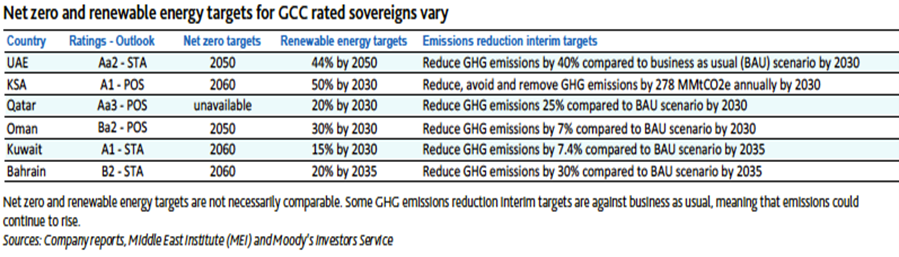
The IAIS should be commended for monitoring climate change as a key trend for the industry, setting up a disclosure workstream, and conducting consultations on updates to its guidance related to climate change. But the scale, pace and urgency are insufficient. Not surprisingly, the signatories recommend the IAIS to i) take a precautionary approach to addressing environmental risk, which remains a regulatory blind spot, ii) should offer best practice guidance to ensure that insurance companies adopt transition plans with short-, medium- and long-term targets and aligned with credible 1.5°C pathways, iii) not to let contributors to the crisis get public support, and iv) to rely on evidenced-based climate science.
With US$6.86 trillion in gross written premiums in 2021, insurance companies are an economic heavy weight with enormous potential to reduce the negative impact on climate change and nature loss through their underwriting business. Insurance regulators and supervisors have a critical leading role to play and can help advance insurance companies to reach global climate and biodiversity goals by aligning insurance regulation, policies and supervision to international best practice and ambitions.
Progress Out of Adversity
But, very often in adversity comes progressive initiatives. A Number of initiatives that have emerged out of COP28 could potentially be game changers in the role and ways de-risking solutions are contributing to the Net Zero ambitions. The first one is the launch of the Net Zero Export Credit Agencies Alliance (NZECAA) by a group of ECAs led by UK Export Finance (UKEF) under the aegis of the United Nations Environment Programme Finance Initiative (UNEP-FI) with the simple mandate of promoting the role of export credit in achieving net zero emissions by 2050 and limiting global warming to 1.5°C, in collaboration with the Glasgow Financial Alliance for Net Zero (GFANZ).
UN Under-Secretary-General and UNEP Executive Director, Inger Andersen could not have been more to the point at the launch of the Alliance. ECAs, she reminded, are in a strong position to deliver more sustainable global trade and to complement the work already being undertaken by the private finance sector, helping to address market gaps to deliver net-zero economies by 2050. “This Alliance will play an important role in supporting tangible economic transition and help countries implement their commitments under the Paris Agreement. Large private financial institutions are powerful, but they cannot deliver net-zero alone. Public finance is the missing piece in net-zero financial landscape. We need the full might of the global financial system to combat and adapt to climate change,” she maintained.
UKEF, with which ICIEC has a long-standing collaboration, recently unveiled multi-million-pound support for transactions supporting climate adaptation and sustainability across Africa and the Middle East, including a GBP226 million facility for the Iraqi Government to develop clean water and sewage treatment infrastructure in Hillah City.
UKEF has declared that it is committed to reaching net-zero in terms of its total financed emissions by 2050, it ended all new support for overseas fossil-fuel projects in 2021, except in very limited circumstances, and recently introduced more flexible and competitive terms for British exporters as part of the Government’s drive to encourage them to use and offer finance solutions and other options which are consistent with the Green Finance agenda in line with the UN SDGs and the Paris Net Zero ambitions. According to the British ECA, it can now offer longer repayment terms and more flexible repayment structures for an expanded range of renewable and green transactions, and for standard transactions.
ICIEC’s Climate Change and ESG Playbook
ICIEC similarly launched its Climate Change Policy and ESG Framework at COP28, which marks “the commencement of a transformative results-oriented process where ICIEC’s operations, insurance, de-risking, physical assets and human capital and focus are addressing the Climate Crisis at their core, based on the needs of ICIEC’s member countries, IsDB Group synergies, the role of the private sector in climate finance and industry best practice.”
ICIEC is committed to helping our 49 Member States achieve their development goals, including resilience, mitigation and adaptation to the threats posed by climate change. ICIEC cover is directed towards various sectors, with US$2.35 billion going specifically into clean energy initiatives such as solar energy systems and wind farms – assisting with their importation and use in national infrastructure projects. At COP28, IsDB President, H.E. Dr. Muhammad Al Jasser, unveiled a US$1 billion climate finance initiative for fragile and conflict-affected member countries over the next three years.
At the same time, ICIEC has granted approvals exceeding US$573 million in support of food security under the Islamic Development Bank (IsDB) Group Food Security Response Programme (FSRP), surpassing our initial commitment of US$500 million for the entire period from SH 2022 until 31 December 2025. ICIEC initiatives in this respect primarily facilitate financial transactions, facilitating the importation of essential agricultural commodities and inputs for agricultural projects, reinforcing resilience against potential food crises.
Collaboration with national, regional and international partners is a key component of ICIEC’s strategy, given the complex risk metrics involved in climate-related events. Earlier this year MUFG Securities EMEA plc structured a €1.247 billion financing package to enable institutional capital investors and syndicate lenders to collaboratively contribute to the package for Türkiye’s green Yerkoy Kayseri Highspeed Railway Project. The Project is backed by a coalition of four European ECAs led by UKEF.
ICIEC participated in this landmark transaction with an 8-year tenor by covering the risks of the Non-Honouring of Sovereign Financial Obligation (NHSFO) of the Ministry of Finance and Treasury of Türkiye of up to €134.1 million, to cover a Syndicated Financing Facility of the same amount led by MUFG Securities EMEA plc and comprising six banks including MUFG, Banco Santander, DZ Bank, Deutsche Bank, Societe Generale and ING Bank. The aim of the project is to improve the efficiency and adequacy of the transportation system in the region by addressing poor rail connectivity and the lack of alternative environmental transport modes. ICIEC played an instrumental role in this impactful transaction, confirming our unwavering commitment to supporting critical infrastructure developments in Türkiye and within ICIEC Member States.
The above developments also follow a change earlier this year to the OECD Arrangement on Officially Supported Export Credits, which allows ECAS and Exim banks to offer greater incentives for climate-friendly transactions.
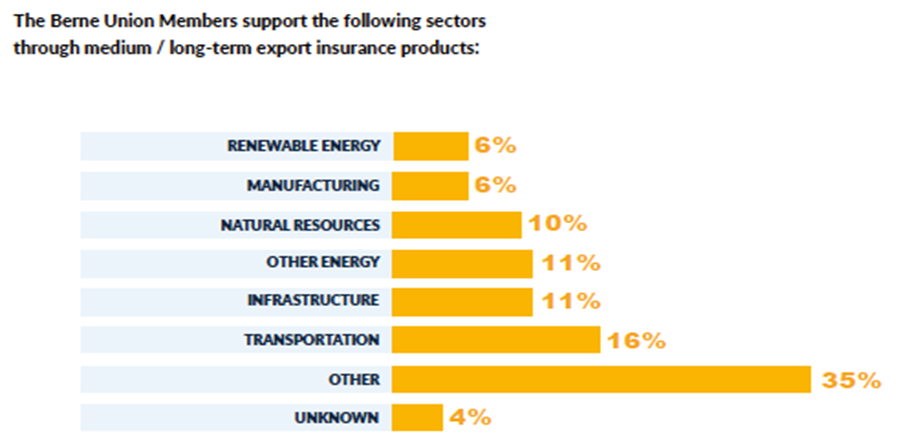
The export credit industry is hugely influential globally with up to US$28 trillion – comprising 80 to 90% – of international trade relying on export financing, much of it provided by governments via export credit agencies and export-import banks. It is the height of folly that governments, international agencies, the COP process and other stakeholders have hitherto failed to capitalise on what the ECII community can bring to the table beyond their vanilla de-risking and credit enhancement solutions. On the other hand, the ECII community and their promoters and shareholders should take some responsibility for this lack of upscaling, underwriting, collaboration and urgency in underwriting climate related and catastrophe risks.
It is noteworthy that the Berne Union Climate Working Group (BU CWG) which is doing important work in supporting the climate goals of the wider export credit community, has come up with a “refreshed BU CWG workplan for 2024” in the wake of the developments at COP28. At the same time, Export Finance for Future (E3F), an international coalition working to align public export finance with climate change and goals. In Dubai, E3F under the motto “Scale Up to Phase Out” confirmed in a debate that momentum is building in its efforts of “gathering a critical mass of countries ready to accelerate the progressive phasing out of Carbon-intensive projects and significantly increase the financial support to exporters’ projects compatible with Paris Climate Agreements”. E3F is also in the process of rolling out National Phase Out Plans for official export credit support for fossil fuels, inviting external monitoring by being transparent about our transactions and now going turbo on scaling up initiatives.
A Future of Proaction and Ambition?
Looking ahead, there are several other positives that indicate a much more proactive and ambitious role for the ECII community in promoting the green economy through climate transition and decarbonization initiatives.
In trade finance, in a post-Covid dispensation, there is a continued push for digitisation, transparency and automation in an environment with increasing regulatory and compliance requirements. In September 2023, the Electronic Trade Documents Act (ETDA) 2023 in the UK received Royal Assent in an effort to make Global Britain’s trade with partners all over the world more straightforward, efficient and sustainable, and which according to the British Government’s initial estimate could give the UK economy a GBP1.14 billion boost over the next decade through the trade documentation digitalisation.
Similarly, the introduction of ISO 20022 by the International Organization for Standardization (ISO), as “a single standardisation approach (methodology, process, repository) to be used by all financial standards initiatives,” is a key development and challenge for the trade finance and credit insurance industry. ISO 20022 (MX), which comes into effect in November 2025, is the next generation of financial messaging standards, given its key characteristics of a common language with rich and structured data. The Swift MT format has been the standard for trade finance messages for the last four decades.
According to Trade Finance Global, (TFG), Swift (the world’s leading provider of secure financial messaging services) is “already in the process of migrating payment and cash management messages from the legacy MT format to MX. In November 2025, when the current MT and MX coexistence period is set to end, all Swift traffic for cross-border payments and reporting (CBPR+) will be on an ISO 20022 standard. As the payments and cash management industry is finding out in real time, there are benefits, challenges and costs associated with such a wholesale transition.
Another unexpected challenge is the consequences of the attacks on ships in the Red Sea and drought in the Panama Canal area that have more than quadrupled shipping prices moving goods since late 2023. Impacts could worsen should disruptions persist into the peak shipping season in the second half of 2024. Swiss Re Institute in its latest Insurance Insight, stressed that marine insurance contracts in affected areas are repricing higher or covers being adjusted, while some claims inflation is a further potential risk.
“For insurers, marine is one of the most impacted lines, as it selectively covers war and terrorism, though not delays. Covers have generally been held for travel through the Red Sea, but with case-by-case flexibility and significant increases in rates to account for the higher risk. Port congestion creates accumulation risks, while longer transit times mechanically raise insureds’ risk exposure, both factors that insurers may need to take into consideration. There are also risks to business interruption and related covers, including Credit & Surety. Exporters appear to be absorbing the delays and higher prices so far, but insured losses may rise if disruptions last longer or intensify. Stickier claims inflation is a risk if core goods inflation ticks up again.”
Increasing geopolitical risks may threaten trade through affected routes. More frequent droughts are likely to jeopardise transit volumes in the Panama Canal, and climate change is already affecting river shipping, as seen in the Rhine and Mississippi.